Thursday
Thursday: Weighing Decisions
"Relay points," Comet says, pinning a card. "5 for first, 3 for second, 1 for third."
"The practice log says keeping our pacer finishes first, second or third equally often," Wren says. "Expected value 3."
"Swapping the pacer late is riskier," Comet says. "First half the time, second one in ten, third two in five."
"5 × 1/2 + 3 × 1/10 + 1 × 2/5 = 3.2," Wren works out. "Swap, by a little."
"What do you notice? The swap finishes third more often and still scores more on average."
Nova projects the bike rack. "Would you like a hint? The worn-tire check is a decision too."
"Our check flags 9 worn tires in 10," Comet says, "but also flags 1 good tire in 10. And most tires are good."
"So a flagged bike is worn only half the time," Wren says after a two-way table. "The table knows."
Expected value weighs a decision
A decision with chance in it has several outcomes, each with a value and a probability.
Its expected value is each value times its probability, added. It is the long-run mean score of that choice.
To compare two choices, find each expected value and pick the larger. The crew calls this weighing the decision.
A solved problem: keep or swap the pacer
- Keep the pacer: first, second and third each with probability 1/3, from the crew's practice log.
- Expected points: 5 × 1/3 + 3 × 1/3 + 1 × 1/3 = 3.
- Swap the pacer late: first with probability 1/2, second 1/10, third 2/5.
- Expected points: 5 × 1/2 + 3 × 1/10 + 1 × 2/5 = 3.2.
- Compare: 3.2 is more than 3. Over many relays, the swap scores more.
- The swap finishes third more often. Expected value says the extra first places outweigh that.
How to build a distribution from a sample space
- List every equally likely outcome of the sample space.
- Give each outcome its number: the value of the random variable.
- Group the outcomes by value.
- Divide each group count by the total number of outcomes: that is each value's probability.
- Check the probabilities add to 1, then multiply each value by its probability and add for the expected value.
- ?Divide each group count by the total: the probabilities
- ?Check they add to 1, then multiply and add for the expected value
- ?Group the outcomes by value
- ?List every equally likely outcome
- ?Give each outcome its number
The worn-tire check on the bike rack
The crew checks 200 bikes on the rack (made up). 20 have a worn tire. The check flags 18 of those and misses 2.
Of the 180 bikes with good tires, the check wrongly flags 18. The two-way table holds every bike.
| flagged | not flagged | Total | |
|---|---|---|---|
| worn tire | 18 | 2 | 20 |
| good tire | 18 | 162 | 180 |
| Total | 36 | 164 | 200 |
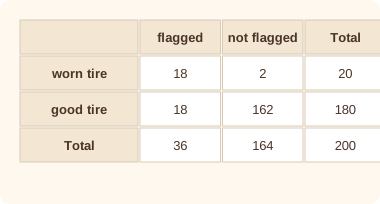
A bike is flagged. Stay in the flagged column: 18 worn out of 36 flagged, so P(worn given flagged) = 1/2.
The check is right 9 times in 10 on each kind of tire, yet half the flags are wrong. Good tires are so common that their few false flags add up.
That is why the crew looks at every flagged bike by hand before saying a tire is worn. A table judges a check better than its rate does.
- Read the question.
- Tap your answer.
Of 200 bikes, 20 have a worn tire. The crew's check finds 18 of those and wrongly flags 18 others. A bike is flagged. What is the chance it really has a worn tire?Given that a bike has a worn tire, what is the probability the check flags it?- Read the question.
- Tap your answer.
| Statement | True or false? |
|---|---|
| Swapping the pacer has expected value 3.2, more than keeping at 3. | ? |
| The choice that finishes first most often always has the higher expected value. | ? |
| 18 ÷ 36 = 1/2 | ? |
| P(flagged given worn) and P(worn given flagged) are the same number here. | ? |
| 18 + 2 + 18 + 162 = 200 | ? |
Find its expected points and rank all three plans.
Sharp thinking. Tomorrow the lane draw is made fair, and the week is reviewed before Race Day.