Friday
Friday: A Fair Draw, and the Week in Review
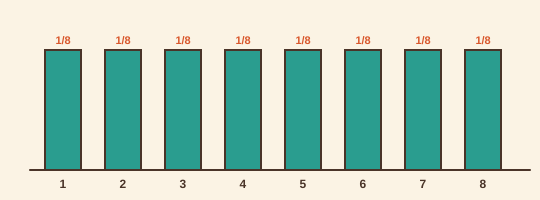
"8 runners in the first heat, 8 tokens, one each," Wren says, filling the bag. "Every runner has 1/8 for lane 1."
"What if someone slipped in a second token?" Comet asks. "9 tokens, two for one runner."
"Then that runner has 2/9 and everyone else 1/9," Wren says. "Not fair. The draw favors one person."
Nova projects eight equal bars, then one tall bar. "Would you like a hint? Fair means flat."
"Flat bars, equal chances," Comet says. "And nobody can tell which token they are grabbing."
"Lots are the oldest fair draw there is," Wren says. "A coin for two, a bag of tokens for eight."
"Tomorrow we run the whole awards table," Comet says. "The draw, the pennant chart, the water cups."
"What do you notice? Everything this course ends up on one table beside the loop."
What makes a draw fair
A draw is fair when every outcome has the same probability. 8 tokens, one per runner, give each runner 1/8.
Fair also means no one can steer it: tokens the same size and shape, shaken, drawn without looking.
A coin flip is fair for two choices. A spinner with equal sectors is fair for as many choices as sectors.
Extra tokens break fairness. With two tokens for one runner in 9, that runner has 2/9 and each other runner 1/9.
Review: the week in five lines
- A random variable gives each outcome a number. Its distribution lists every value with its probability.
- Theoretical probabilities come from a sample space of equally likely outcomes. Empirical ones come from a tally.
- Expected value = each value × its probability, added. It is the mean of the distribution.
- Weigh a decision by comparing expected values. Read a check with a two-way table, not just its rate.
- A fair draw gives every outcome the same probability and lets no one steer it.
- Read the question.
- Tap your answer.
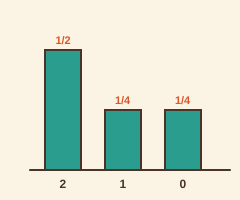 A heat awards 2 pennants with probability 1/2, 1 with probability 1/4, 0 with probability 1/4. What is the expected number of pennants?
- Read the question.
- Tap your answer.
| Statement | True or false? |
|---|---|
| A fair draw gives every outcome the same probability. | ? |
| Adding a second token for one runner keeps the draw fair. | ? |
| 8 × 1/8 = 1 | ? |
| A coin flip is a fair way to decide between two runners. | ? |
| A plan is judged by its most likely outcome alone, never by expected value. | ? |
Then design an unfair one on purpose and say exactly whose probability changed.
Fine week's work. Tomorrow is Race Day. The table is yours to run.