Tuesday
Tuesday: What Chance Alone Can Do
"Suppose the warm-up made no difference at all," Wren says. "Then each runner's time is just that runner's time."
"And the red-blue split was pure chance," Comet says. "So any split is as likely as the one we got."
Wren writes the 12 lap times on 12 cards. Shuffle. Deal six and six. "Difference: -5."
Again. -4. Again. 0. Nova logs each one. Twenty-five shuffles later a dot plot has grown.
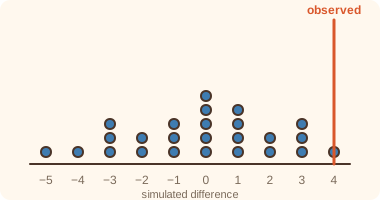
"What do you notice?" Wren asks. "Most shuffles land between -3 and 3. Only 1 reached 4 or more."
"1 of 25 is 4%," Comet says. "Chance alone rarely makes a gap as big as ours."
Nova glows. "Would you like a hint? The crew's rule says under 5% is significant."
"Then the jog really did help our runners," Comet says. "Chance is not a good enough explanation."
Way 1: re-randomize with cards
If the treatment did nothing, the lap times belong to the runners, not to the groups. Any shuffle of the cards is a split chance could have made.
Shuffle all 12 time cards, deal 6 and 6, and find the difference of means. Record it. Repeat many times.
The dot plot of shuffled differences shows what chance alone does. Then the crew asks where its observed difference lands.
| Shuffle | 1 | 2 | 3 | 4 | 5 | 6 | 7 | 8 | 9 | 10 | 11 | 12 | 13 |
|---|---|---|---|---|---|---|---|---|---|---|---|---|---|
| Difference | -5 | -4 | -3 | -3 | -3 | -2 | -2 | -1 | -1 | -1 | 0 | 0 | 0 |
| Shuffle | 14 | 15 | 16 | 17 | 18 | 19 | 20 | 21 | 22 | 23 | 24 | 25 |
|---|---|---|---|---|---|---|---|---|---|---|---|---|
| Difference | 0 | 0 | 1 | 1 | 1 | 1 | 2 | 2 | 3 | 3 | 3 | 4 |
Way 2: the 5% rule
Count the shuffles at or beyond the observed difference. Here 1 of 25 reached 4 or more: 4%.
Under 5%: chance alone rarely gives a gap this big, so the difference is significant. The treatment is the best explanation.
5% or more: chance alone could easily give this gap. The crew cannot tell the treatment apart from luck.
The picture and the percent say the same thing. The dot plot shows it; the percent names it.
- Read the question.
- Tap your answer.
- Read the question.
- Tap your answer.
| Statement | True or false? |
|---|---|
| 1 ÷ 25 × 100 = 4 | ? |
| A significant difference means chance alone rarely produces one that big. | ? |
| Significant means the treatment is proven to work for every runner everywhere. | ? |
| More shuffles make the dot plot a better picture of chance. | ? |
Do it five times and mark each difference on a number line from -6 to 6. Where does 4 sit?
Two ways that agree. Tomorrow is Data Lab: your hands shuffle, your dot plot grows, and you judge the gap yourself.