Monday
Monday: Two Warm-Ups and a Shuffled Deck
"Which warm-up is better, the stretch routine or the loop jog?" Comet asks. "12 runners want to know."
"Then we do not let them choose," Wren says, shuffling a deck of six red and six blue cards.
"Red stretches. Blue jogs the loop. The card decides, not the runner."
Each runner draws a card, warms up, and runs one timed lap. Nova logs every second.
"Stretch group mean 94 seconds," Nova reports. "Jog group mean 90. Would you like a hint? Look at the difference."
"4 seconds faster after the jog," Comet says. "So the jog is better!"
"Maybe," Wren says. "What do you notice? Six runners each. Chance could have put the fast runners in blue."
"Then we need to know what chance alone can do," Comet says. "And this deck is going to tell us."

A randomized experiment
An experiment assigns a treatment. The crew's treatments are the stretch routine and the loop jog.
Random assignment lets chance choose the groups. With a shuffled deck, no runner, fast or slow, is more likely to land in either group.
That is why a randomized experiment can point to a cause: the only things separating the groups are the treatment and chance.
Every lap time in this course is the crew's own made-up reading from Nova's Run Log.
A solved problem to study
Here is how Wren finds the difference the crew observed.
- Stretch group lap times: 95, 92, 97, 94, 96, 90 seconds. Add them: 564. Divide by 6: mean 94.
- Jog group lap times: 88, 91, 86, 93, 90, 92 seconds. Add them: 540. Divide by 6: mean 90.
- Difference of means, stretch minus jog: 94 - 90 = 4 seconds.
- A positive difference means the jog group ran faster. The question for the week: could chance alone make a gap of 4?
| Group | Lap times (seconds) | Mean |
|---|---|---|
| Stretch (red cards) | 95, 92, 97, 94, 96, 90 | 94 |
| Jog (blue cards) | 88, 91, 86, 93, 90, 92 | 90 |
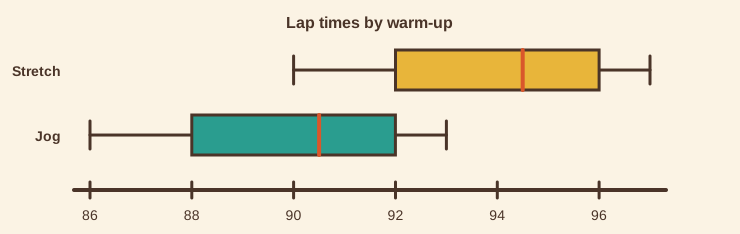
- Read the question.
- Tap your answer.
- Read the question.
- Tap your answer.
| Statement | True or false? |
|---|---|
| 94 - 90 = 4 | ? |
| Random assignment means the runner picks the warm-up they prefer. | ? |
| A difference of 4 seconds proves the jog is better. | ? |
| In a randomized experiment, only the treatment and chance separate the groups. | ? |
Shuffle and deal six and six. Find each hand's mean and the difference. Was it bigger or smaller than 4?
A strong start. Tomorrow the deck answers the question: what can chance alone do to twelve lap times?