Wednesday
Wednesday: Data Lab, Draws from the Token Bag
"Lab day," Comet says, shaking a cloth bag. "20 tokens. 12 are marked M for morning."
"So the bag's true proportion is 0.6," Wren says. "Today we pretend we do not know that. We sample."
"Draw 10, one at a time, putting each back," Comet says. "Count the Ms. Then do it again."
Nova logs ten rounds: 6, 7, 5, 8, 6, 7, 6, 4, 7, 6 Ms out of 10.
"Round 2 gave 7 of 10, that is 70%," Wren says. "The rule's margin for n = 10 is 29%. What do you notice?"
"Huge," Comet says. "70% plus or minus 29% covers almost everything."
"Ten draws is a tiny sample," Wren says. "The bracket is honest about that."
Nova glows. "Would you like a hint? Every round's interval should still catch the true 60%."
What you need
- A cloth bag or a box, and 20 tokens or paper scraps, 12 of them marked M.
- Your Run Log, a pencil and graph paper for a dot plot from 0 to 10.
- A flat surface so tokens do not roll away.
Cut paper scraps with scissors on paper or cardboard, over the table. Keep small tokens away from younger children.
Nothing heavy is lifted alone. Pick up any dropped token so no one slips.
Run the lab
- Mark 12 of your 20 tokens with an M. Put all 20 in the bag and shake.
- Draw one token, write M or not, put it back and shake. Repeat 10 times. That is one round.
- Count the Ms in the round and write the count in your Run Log. Do 10 rounds in all.
- Turn one round into a percent and find its margin with 2√(p(1 - p)/10). Write the interval.
- Make a dot plot of your 10 counts from 0 to 10. Mark the true count, 6, on it.
- Check each round's interval: does it include the true 60%? Count how many do.
The crew's lab results
The crew's 10 rounds are made up for the Run Log. Yours will differ, and the comparison is the point.
| Round | 1 | 2 | 3 | 4 | 5 | 6 | 7 | 8 | 9 | 10 |
|---|---|---|---|---|---|---|---|---|---|---|
| Ms in 10 draws | 6 | 7 | 5 | 8 | 6 | 7 | 6 | 4 | 7 | 6 |
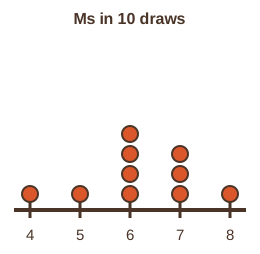
The crew's mean count is 6.2, near the true 6. Each round's sample percent wandered, and each bracket was wide.
With n = 10, the margin for a 70% sample is 29%. A tiny sample gives an honest but almost useless bracket.
- Read the question.
- Tap your answer.
| Statement | True or false? |
|---|---|
| 12 ÷ 20 = 0.6 | ? |
| A sample of 10 gives a smaller margin than a sample of 50. | ? |
| Every one of the crew's 10 rounds gave exactly 6 Ms. | ? |
| A sample percent can miss the true percent and still be a fair estimate. | ? |
Good lab work. Tomorrow the same idea estimates a mean: the crew's stretch times and a bracket in seconds.