Thursday
Thursday: A Margin for a Mean
"The warm-up stretch," Comet says. "We timed 8 runners drawn from the bag. Mean 43 seconds."
"A sample mean," Wren says. "The whole group's mean is what we want. Same question: how far off might we be?"
"There is no p for a mean," Comet says. "What do you notice we can still do?"
"Simulate," Wren says. "Draw samples of eight from the Run Log over and over. Record each mean."
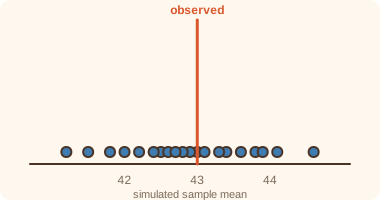
Nova logs twenty simulated means. "They run from 41.2 to 44.6. Would you like a hint? Find their standard deviation."
"About 0.87 seconds," Comet says. "Two of those is 1.7."
"So the whole group's mean is most likely 41.3 to 44.7 seconds," Wren says. "A bracket in seconds."
"Same idea, different unit," Comet says. "The bracket is the spread of the simulated estimates."
The same idea for a mean
A sample mean estimates the whole-group mean. Chance moves it, just as it moved the sample percent.
The margin for a mean comes from simulation. Re-draw samples of the same size many times, find each mean, and take two standard deviations.
For the crew's stretch times: sample mean 43 seconds, simulated spread 0.87, margin 1.7, interval 41.3 to 44.7 seconds.
| The crew's sample of 8 stretch times (seconds) |
|---|
| 44, 41, 46, 43, 40, 45, 42, 43 |
| Twenty simulated sample means (seconds) | |
|---|---|
| 41.2, 42.5, 43.8, 42, 44.1, 43, 42.6, 41.8, 43.4, 42.9 | 44.6, 42.2, 43.1, 41.5, 42.8, 43.6, 42.4, 43.9, 42.7, 43.3 |
- Read the question.
- Tap your answer.
Why the margin shrinks with n
The reasoning behind the square root, built from the simulation. Read it first, then put it in order.
- A sample estimate wanders because chance picks different runners each time.
- In a bigger sample, high and low runners are more likely to balance each other out.
- So the simulated estimates from bigger samples bunch closer together.
- The standard deviation of the estimates shrinks with the square root of n.
- The margin is two standard deviations, so it shrinks the same way.
- Four times the sample halves the margin. A hundred times the sample cuts it to one tenth.
- ?Their standard deviation shrinks with √n
- ?The margin is two standard deviations, so it shrinks too
- ?The simulated estimates bunch closer together
- ?Chance picks different runners, so an estimate wanders
- ?A bigger sample balances high and low runners better
- ?Four times the sample halves the margin
- Read the question.
- Tap your answer.
| Statement | True or false? |
|---|---|
| 344 ÷ 8 = 43 | ? |
| A sample mean estimates the whole-group mean exactly. | ? |
| The margin for a mean is two standard deviations of the simulated sample means. | ? |
| A sample of 100 has a smaller margin than a sample of 25. | ? |
Careful thinking. Tomorrow you read reports the way the crew does: looking for the sample size and the bracket.