Tuesday
Tuesday: Where the Margin Comes From
"Suppose the whole bag really is 60% morning," Wren says. "What would samples of 50 look like?"
"Let us find out," Comet says. She fills a bag with tokens, 60% of them marked M, and draws 50.
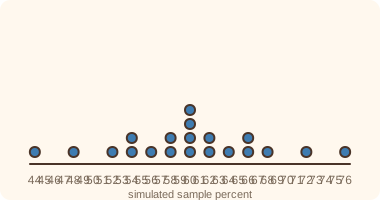
Nova logs each draw as a percent. Twenty draws later the list reads 44, 48, 52, 54, 54, 56 and on.
"They bunch around 60%," Wren says. "The standard deviation of the twenty percentages is about 7.5. What do you notice?"
"Two of those is 15%," Comet says. "Close to the 13.9% from the rule."
"The rule is a shortcut for this picture," Wren says. "Two standard deviations of the simulated percentages."
Nova glows. "Would you like a hint? Try the rule with a bigger n and watch the bracket shrink."
"Two hundred cards gives 6.9%," Comet says. "Four times the sample, half the margin."
Way 1: simulate the draws
Build a bag that matches the estimate: 60% of the tokens marked M. Draw a sample of 50, count the Ms, and record the percent.
Repeat many times. The dot plot of sample percentages shows how far a random sample of this size wanders.
Two standard deviations of those percentages is the margin of error. About 95% of random samples land inside it.
| Simulated sample percentages (20 draws of 50) | |
|---|---|
| 44, 48, 52, 54, 54, 56, 58, 58, 60, 60 | 60, 60, 62, 62, 64, 66, 66, 68, 72, 76 |
Way 2: the crew's rule
Many simulations like this one agree on a shortcut: the standard deviation of sample proportions is close to √(p(1 - p)/n).
Doubling it gives the margin: 2√(p(1 - p)/n). The crew uses this rule when it cannot draw hundreds of samples.
For p = 0.6 and n = 50 the rule gives 13.9%. The simulation gave 15%. Both ways agree closely.
How the margin shrinks
| Sample size n | Margin for p = 0.6 | Interval |
|---|---|---|
| 50 | 13.9% | 46.1% to 73.9% |
| 100 | 9.8% | 50.2% to 69.8% |
| 200 | 6.9% | 53.1% to 66.9% |
| 800 | 3.5% | 56.5% to 63.5% |
The n sits under a square root. Four times the sample makes the margin 2 times smaller, not four times smaller.
- Read the question.
- Tap your answer.
- Read the question.
- Tap your answer.
| Statement | True or false? |
|---|---|
| 50 × 4 = 200 | ? |
| Doubling the sample size halves the margin of error. | ? |
| About 95% of random samples land within the margin of the whole-group number. | ? |
| The simulated margin 15% and the rule's 13.9% are close. | ? |
Repeat 5 times and write the five percentages. How far do they wander from 60%?
Two ways that agree. Tomorrow is Data Lab: your own bag, your own draws and your own bracket.