Monday
Monday: A Percent and Its Bracket
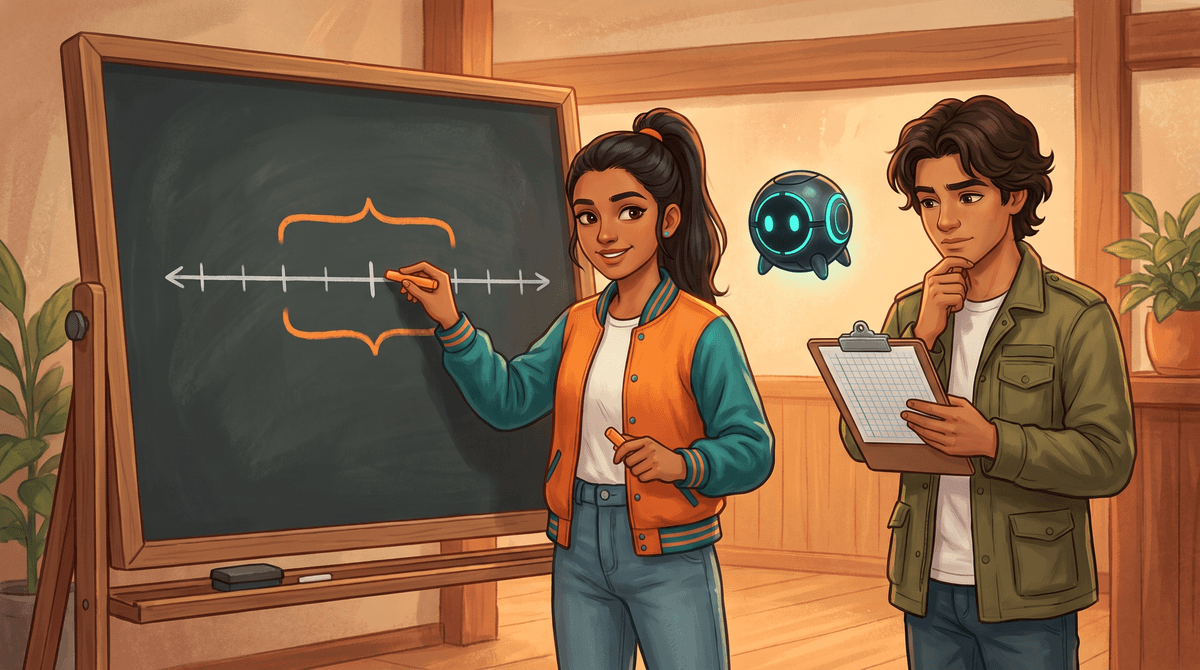
The community center lobby has a big poster. In chalk it says "60% want a morning start" with a bracket drawn under it.
"We asked 50 runners, drawn from the bag of 240 sign-up cards," Comet says. "30 said morning."
"60% of the sample," Wren says. "But not exactly 60% of all 240. What do you notice about the bracket?"
Nova lights up the bracket. "Would you like a hint? A different draw of fifty would give a different percent."
"So the bracket says how far off we might be," Comet says. "Plus or minus 13.9%."
"From 46.1% to 73.9%," Wren says. "The whole group is most likely somewhere in there."
"That is a wide bracket," Comet says, frowning.
"Fifty cards is a small sample," Wren says. "A bigger sample would draw a tighter one. Let us learn the rule."
From a sample to the whole group
The population is every sign-up card, 240 of them. The sample is the 50 cards the crew drew at random.
The sample proportion p = 30/50 = 0.6 is a statistic. The proportion of all 240 cards is the parameter the crew wants.
A random sample gives a fair estimate, but chance moves it. The margin of error says how far chance usually moves it.
Every card and count in this course is the crew's own made-up reading from Nova's Run Log.
A solved problem to study
Here is how Wren puts the bracket on the poster, with the crew's rule 2√(p(1 - p)/n).
- Find the sample proportion: p = 30 ÷ 50 = 0.6, or 60%.
- Find p(1 - p): 0.6 × 0.4 = 0.24.
- Divide by n: 0.24 ÷ 50 = 0.0048.
- Take the square root: √0.0048 ≈ 0.0693. Double it: ≈ 0.139, or 13.9%.
- The interval: 60% - 13.9% = 46.1% up to 60% + 13.9% = 73.9%.
The crew reads it: "about 60% of all sign-ups want a morning start, give or take 13.9%."
| Sample size n | Sample percent | Margin 2√(p(1 - p)/n) | Interval |
|---|---|---|---|
| 50 | 60% | 13.9% | 46.1% to 73.9% |
- Read the question.
- Tap your answer.
- Read the question.
- Tap your answer.
| Statement | True or false? |
|---|---|
| 30 ÷ 50 = 0.6 | ? |
| The sample percent 60% is exactly the percent of all 240 cards. | ? |
| The whole-group percent is most likely between 46.1% and 73.9%. | ? |
| The margin of error says how far a random sample usually lands from the whole-group number. | ? |
Say out loud what the bracket means. Practice until it comes out in one sentence.
A strong start. Tomorrow you see where the rule comes from: a bag, many draws and a dot plot of percentages.