Thursday
Thursday: Association, and the Table as a Sample Space
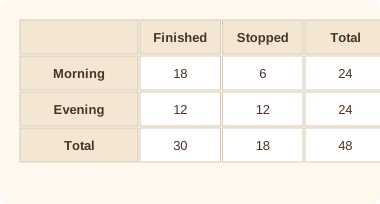
"Finished given morning 75%, given evening 50%," Wren says. "A 25-point gap. Morning and finishing are associated."
"Associated means knowing the slot changes the finishing percent," Comet says. "Not that mornings cause finishing."
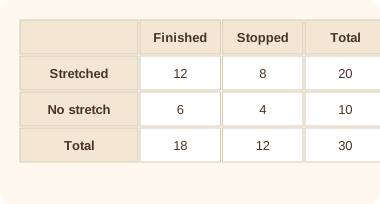
Wren pins up a second table. "Stretched or not, against finished or stopped. 12, 8, 6, 4."
"Finished given stretched is 3/5," Comet says. "Given no stretch, 3/5. The same. What do you notice?"
"No association," Wren says. "Knowing whether a runner stretched tells you nothing about finishing, in our cards."
Nova lights one card on the grid. "Would you like a hint? Pick a card at random. The table is now a sample space."
"P(finished) is 30 of 48," Comet says. "P(finished given morning) is 18 of 24. Same fractions, new names."
Judging an association
Compare the conditional percentages across the rows. If they differ by 10 points or more, the crew says the two questions are associated.
Sign-up cards: 75% against 50%, a gap of 25 points. Associated.
Stretch cards: 60% against 60%. No gap at all. Not associated.
An association is a pattern in the table. It is not proof that one thing caused the other. The slot was chosen, not assigned.
| Finished | Stopped | Total | |
|---|---|---|---|
| Stretched | 12 | 8 | 20 |
| No stretch | 6 | 4 | 10 |
| Total | 18 | 12 | 30 |
The table as a sample space
Pick one sign-up card at random. Every card is one outcome, so the whole table is the sample space.
P(finished) is the finished total over the grand total: 30 ÷ 48 = 5/8. That is the marginal percent as a fraction.
P(finished given morning) is the cell over the morning total: 18 ÷ 24 = 3/4. That is the conditional percent as a fraction.
Independence test: P(finished and morning) = 3/8, but P(finished) × P(morning) = 5/16. Not equal, so not independent.
Stretch table: P(finished and stretched) = 2/5 and P(finished) × P(stretched) = 2/5. Equal, so independent.
Why a conditional percent uses the group total
- Read the "given" group. It names one row or one column.
- Only the cards in that group are possible now, so that group is the new whole.
- Count the cards in the group that also have the second feature.
- Divide that count by the group total, not by the grand total.
- Multiply by 100 to write it as a percent of the group.
- ?Read the "given" group
- ?That group becomes the new whole
- ?Count the cards in the group with the second feature
- ?Divide by the group total, not the grand total
- ?Multiply by 100
- Read the question.
- Tap your answer.
 Sign-up cards: finished given morning is 75% and given evening is 50%. Does the table suggest an association?Stretch cards: finished given stretched is 60% and given no stretch is 60%. Does the table suggest an association?
- Read the question.
- Tap your answer.
One of the 48 sign-up cards is picked at random. What is the probability it says finished?Given that the picked card is a morning card, what is the probability it says finished?Careful thinking. Tomorrow you read two-way tables in everyday sentences and review the week.