Wednesday
Wednesday: Data Lab, the Coin-Flip Sign-Up Cards
"Lab day," Comet says, dealing 24 blank index cards onto the picnic table.
"Each card gets two coin flips," Wren says. "First flip heads: write Morning. Tails: Evening."
"Second flip heads: write Finished. Tails: Stopped," Comet says. "Then we sort the piles, like the real cards."
Comet flips, Wren writes, Nova tallies. "7 morning and finished. 5 morning and stopped."
"6 evening and finished. 6 evening and stopped," Nova finishes. "Would you like a hint? The second flip never saw the first."
"So the conditional percentages should be close," Wren says. "Finished given morning 58.3%, given evening 50%."
"Close, not equal," Comet says. "Twenty-four cards is a small stack. What do you notice about the real cards?"
"Their gap was much bigger," Wren says. "Bigger than coin flips make by accident."
What you need
- 24 index cards or paper scraps cut with scissors, a coin and a pencil.
- Two strips of tape or string to make a grid of four piles on the table.
- Your Run Log for the tally.
Any walking or jogging today is on the park loop or a safe path with a grown-up aware. Never on a road.
Water is at hand. Nothing heavy is lifted alone.
Run the lab
- Number 24 cards. Make a tape grid with two rows (Morning, Evening) and two columns (Finished, Stopped).
- For card 1, flip the coin. Heads: write Morning. Tails: write Evening.
- Flip again. Heads: write Finished. Tails: write Stopped. Place the card in its pile.
- Repeat for every card. Count the four piles and write the row and column totals.
- Find the joint percent for morning and finished, the marginal percent for finished, and both conditional finished percentages.
- Compare finished given morning with finished given evening. Write how far apart they are.
The crew's lab table
The crew's counts are made up for the Run Log. Yours will differ, and the comparison is the point.
| Finished | Stopped | Total | |
|---|---|---|---|
| Morning | 7 | 5 | 12 |
| Evening | 6 | 6 | 12 |
| Total | 13 | 11 | 24 |
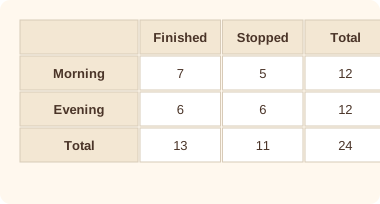
In the crew's run, finished given morning is 58.3% and finished given evening is 50%. The flips were separate, so the true chances match.
A small stack rarely matches exactly. A gap this small is the kind that coin flips make on their own.
- Read the question.
- Tap your answer.
Among the 12 morning lab cards, what percent say finished? (Round to 1 place.)Among the 12 evening lab cards, what percent say finished? (Round to 1 place.)Of all 24 lab cards, what percent are both morning and finished? (Round to 1 place.)Of all 24 lab cards, what percent say morning? (Round to 1 place.)| Statement | True or false? |
|---|---|
| The two coin flips were separate, so the true conditional percentages are equal. | ? |
| 7 + 5 + 6 + 6 = 24 | ? |
| A small stack of cards will always match the true chances exactly. | ? |
| The crew's real sign-up cards showed a gap of 25 points, much bigger than the lab gap. | ? |
Good lab work. Tomorrow you decide what counts as an association, and you use the table as a sample space.