Friday
Friday: Everyday Tables
"My cousin says most runners who warmed up picked the short loop," Comet says. "So warming up makes you pick the short loop?"
"Careful," Wren says. "That is warm-up runners, then loop. Flip it: short-loop runners, then warm-up. Different totals."
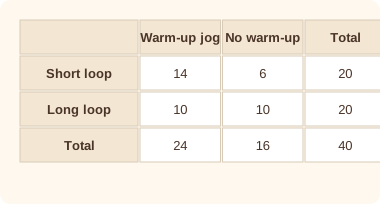
He lays out the loop cards. "Short loop: 14 jogged, 6 did not. Long loop: 10 and 10."
"Warm-up given short loop is 70%," Comet says. "Given long loop, 50%. A 20-point gap. Associated."
Nova shows two tables, one with a row lit and one with a column lit. "Would you like a hint? Say the group out loud first."
"Among the short-loop runners," Comet says slowly. "Among the warm-up runners. Two groups, two questions."
"Everyday talk mixes them up all the time," Wren says. "Our poster will not."
Saying it in everyday words
"Among the morning runners, three in four finished" is a conditional percent with the morning row as the whole.
"Among the finished runners, most had morning slots" is a different conditional percent, with the finished column as the whole.
"Associated" in everyday words: the finishing percent is different for morning and evening runners. Not associated: the percent is the same either way.
| Warm-up jog | No warm-up | Total | |
|---|---|---|---|
| Short loop | 14 | 6 | 20 |
| Long loop | 10 | 10 | 20 |
| Total | 24 | 16 | 40 |
| Everyday sentence | Percent it means |
|---|---|
| Among the morning runners, three in four finished. | finished given morning: 75% |
| Among the finished runners, most had morning slots. | morning given finished: 60% |
| Of all the cards, more than half are finished and under half are morning and finished. | 62.5% marginal, 37.5% joint |
| Stretching made no difference to finishing. | 60% either way: not associated |
Review: the week in one list
- Joint: cell ÷ grand total. Marginal: edge total ÷ grand total. Conditional: cell ÷ its own row or column total.
- Compare conditional percentages across rows. A gap of 10 points or more suggests an association.
- Association is a pattern, not a cause.
- As a sample space: P(A) = count ÷ total. P(A given B) = cell ÷ B's total. Independent when P(A given B) = P(A).
- Read the question.
- Tap your answer.
Among the 20 short-loop runners, what percent did the warm-up jog? (Round to 1 place.)Among the 20 long-loop runners, what percent did the warm-up jog? (Round to 1 place.)Warm-up given short loop is 70% and given long loop is 50%. Does the loop table suggest an association?Given that a picked loop card says warm-up jog, what is the probability it is a short-loop card?- Read the question.
- Tap your answer.
| Statement | True or false? |
|---|---|
| "Among the morning runners" and "among the finished runners" use different totals. | ? |
| 12 ÷ 48 = 0.25 | ? |
| A 20-point gap between conditional percentages suggests an association. | ? |
| An association in the loop table proves warming up makes runners pick the short loop. | ? |
Read them to someone and ask which total each one uses.
A full week of tables. Tomorrow is Track Day: sort something at home two ways at once.