Thursday
Thursday: Weighing a Decision
"Points on Regatta Day," Comet says, pinning a card. "5 for first, 3 for second, 1 for third."
"The practice log says Kestrel finishes first half the time, second a third, third a sixth," Wren says.
"So how many points should Kestrel expect in a heat?"
Comet multiplies. "5 × 1/2 + 3 × 1/3 + 1 × 1/6. That is 11/3."
"About three and two thirds," Wren says. "Not a score anyone gets. The mean over many heats."
Nova projects two cards, Steady and Sprint. "Would you like a hint? Weigh each strategy the same way."
"Steady gets 3. Sprint gets 2.6," Comet says after a minute. "Steady, by a little."
"What do you notice? Sprint wins more often than it loses, and still scores less on average."
Expected value weighs a decision
A decision with chance in it has several outcomes, each with a value and a probability.
Its expected value is each value times its probability, added. It is the long-run mean score of that choice.
To compare two strategies, find each expected value and pick the larger. The crew calls this weighing the decision.
Kestrel's heat: 5 × 1/2 + 3 × 1/3 + 1 × 1/6 = 11/3 points per heat, in the long run.
A solved problem: Steady or Sprint
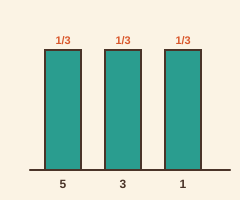
- Steady: first, second and third each with probability 1/3, from the crew's practice log.
- Expected points: 5 × 1/3 + 3 × 1/3 + 1 × 1/3 = 3.
- Sprint: first with probability 2/5, third with probability 3/5, never second.
- Expected points: 5 × 2/5 + 1 × 3/5 = 2.6.
- Compare: 3 is more than 2.6. Over many heats, Steady scores more.
- Sprint is exciting and often first. Expected value says the slow third places drag it down.
Why P(A and B) = P(A) × P(B given A)
Monday's rule, proved by counting the ordered pairs of draws. Read it first, then put it in order.
- The bag has 6 tokens, so two draws make 6 × 5 = 30 ordered pairs, all equally likely.
- Pairs with a red first: 3 × 5 = 15. So P(A) = 15/30.
- Among those 15 pairs, the ones with a blue second: 3 × 2 = 6. So P(B given A) = 6/15.
- Pairs with red first and blue second are those same 6, out of all 30. So P(A and B) = 6/30.
- Multiply: 15/30 × 6/15 = 6/30. The 15 cancels.
- In general: (A pairs ÷ all) × (A and B pairs ÷ A pairs) = A and B pairs ÷ all. That is the rule.
- ?Two draws make 30 equally likely ordered pairs
- ?6 of those have a blue second, so P(B given A) = 6/15
- ?15/30 × 6/15 = 6/30, the shared 15 cancels
- ?Those 6 pairs are the A and B pairs, so P(A and B) = 6/30
- ?15 pairs have a red first, so P(A) = 15/30
- ?So P(A and B) = P(A) × P(B given A)
- Read the question.
- Tap your answer.
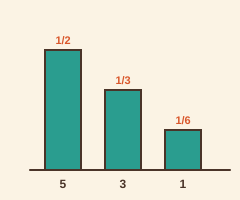 Kestrel scores 5 points with probability 1/2, 3 with probability 1/3, 1 with probability 1/6. What is the expected value, in points?
- Read the question.
- Tap your answer.
| Statement | True or false? |
|---|---|
| Expected value is the long-run mean of a random variable. | ? |
| Steady's expected value of 3 beats Sprint's 2.6. | ? |
| The strategy that wins most often always has the higher expected value. | ? |
| 5 × 2 + 1 × 3 = 13 | ? |
| An expected value of 11/3 points means a boat can score 11/3 in one heat. | ? |
Find its expected points and rank all three strategies.
Sharp thinking. Tomorrow the crew makes the lane draw fair and plans the Regatta Day table.