Friday
Friday: A Fair Draw
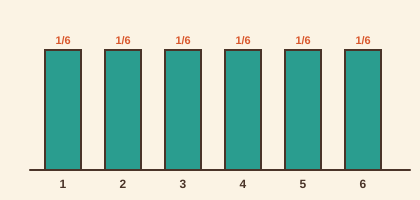
"Six boats, six tokens, one each," Wren says, filling the bag. "Every boat has a 1/6 chance of lane 1."
"What if Osprey's crew slipped in a second token?" Comet asks. "Seven tokens, two of them Osprey."
"Then Osprey has 2/7 and everyone else 1/7," Wren says. "Not fair. The draw favors one boat."
Nova projects the six probabilities as six equal bars, then one tall bar. "Would you like a hint? Fair means flat."
"Flat bars, equal chances," Comet says. "And nobody can tell which token they are grabbing."
"Lots are the oldest fair draw there is," Wren says. "A coin flip for two, a bag of tokens for six."
"Tomorrow we run the whole table," Comet says. "The draw, the count of heats, and the expected-value chart."
"What do you notice? Everything this week ends up on one table on the shore."
What makes a draw fair
A draw is fair when every outcome has the same probability. Six tokens, one per boat, give each boat 1/6.
Fair also means no one can steer it: tokens the same size and shape, shaken, drawn without looking.
A coin flip is fair for two choices. A spinner with equal sectors is fair for as many choices as sectors.
Extra tokens break fairness. With two Osprey tokens in seven, Osprey has 2/7 and each other boat 1/7.
Analyzing a strategy
Probability also judges plans. Suppose a heat is re-rowed whenever two boats tie, and ties happen about one heat in ten.
Expected re-rows in ten heats: 10 × 1/10 = 1. The plan adds about one extra heat a day. The crew can live with that.
Suppose instead the rule re-rows any heat where the winner is a boat's length ahead or less. The log says that is half of heats.
Expected re-rows: 10 × 1/2 = 5. Five extra heats make a long day. The crew drops that rule before it starts.
The pattern is the same every time: name the outcomes, attach probabilities, and weigh what the plan would do.
Mixed review
- Read the question.
- Tap your answer.
- Read the question.
- Tap your answer.
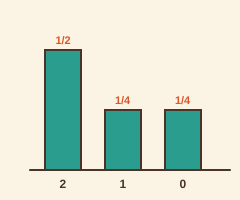 A heat awards 2 pennants with probability 1/2, 1 with probability 1/4, 0 with probability 1/4. What is the expected number of pennants?
| Statement | True or false? |
|---|---|
| A fair draw gives every outcome the same probability. | ? |
| Adding a second token for one boat keeps the draw fair. | ? |
| 6 × 1 = 6 | ? |
| A coin flip is a fair way to decide between two boats. | ? |
| A plan is judged by its most likely outcome alone, never by expected value. | ? |
Then design an unfair one on purpose and say exactly whose probability changed.
Fine week's work. Tomorrow is Regatta Day. The table is yours to run.