Dock Day
Regatta Day: Run the Table
Pennants flutter along the dock. Six boats wait in the lanes, life vests on, a grown-up at the ramp.
Comet holds up the bag. "Six tokens, one per boat. Fair draw for the first heat." Three names come out.
Wren pins a card to the table. "C(6, 3) = 20 possible heats, 10 ways to split six boats into two."
Beside it hangs Wednesday's expected-value chart, three bars and a mean of one red.
Nova hovers over the table. "Would you like a hint? Explain each card in one sentence to anyone who stops."
"The draw is fair because every token is the same," Comet tells a family. "The count says how many heats we could have drawn."
"And the chart says what to expect over many draws," Wren adds. "Now you run yours at home."
"What can we make next?" Comet asks as the first heat pushes off.
- Without replacement, P(A and B) = P(A) × P(B given A). The second fraction comes from the smaller bag.
- Permutations count orders and combinations count groups: C(n, k) = P(n, k) ÷ k!. Favorable over all gives a probability.
- A random variable numbers the outcomes. Its distribution is graphed as bars, and its expected value is the long-run mean.
- Expected value weighs a decision: find each option's mean and compare. Fair draws give every outcome the same probability.
- The Boathouse is open. Every reading in the log was the crew's own, and every answer was computed.
Card 1: put six identical tokens in a bag, one per family member or toy boat. Draw three for the first heat. Explain why the draw is fair.
Card 2: show C(6, 3) = 20 and how it came from P(6, 3) = 120 ÷ 6. Let someone check the division.
Card 3: show your Wednesday chart with its expected value. Draw two tokens from a 3-red bag ten times and compare the mean of reds.
Let each family member run one card. Trade until everyone has done the draw.
If a real boat is part of the day, life vests are worn and a grown-up is at the water's edge.
The counts and probabilities are the family's own game, not facts about any real regatta.
- Read the question.
- Tap your answer.
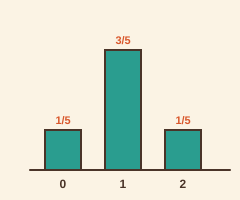 Card 3: two draws give 0, 1 or 2 reds with probabilities 1/5, 3/5, 1/5. What is the expected number of reds?