Wednesday
Wednesday: Boathouse Lab, the Chalk Walk
Comet chalks a grid of one-meter squares on the dry pavement behind the shed. A grown-up holds the tape.
"We cannot measure the lake drift with a tape," Wren says. "So we walk it on land."
"Walk one: three squares east for rowing, then four squares north for drift," Comet reads from the log.
She walks it, heel to toe along the chalk lines, and stops. Wren stretches the tape from start to finish.
"5 meters," he says. "What do you notice? Three, four, five."
Nova projects the two legs and the straight line home. "Would you like a hint? The tape is the hypotenuse."
"So the tape measures the magnitude of the sum," Comet says. "Let us try a longer one."
"And one with an angled rowing leg," Wren says. "The components still add."
What you need
- Sidewalk chalk, a tape measure, your Boathouse Log and a dry, flat stretch of pavement or a lawn with string lines.
- A partner to hold the tape, and a grown-up nearby.
- If you have no pavement, use graph paper on the table with a ruler instead of a tape.
Walk, never run, along the chalk lines. Look where you step.
On the lake itself the crew wears life vests, and a grown-up is on the dock. The lab stays on land.
Nothing heavy is lifted alone, and chalk dust is washed off hands afterward.
Run the lab
- Chalk a grid of squares one big step wide, at least 10 squares by 10. Mark a start point S.
- Read a rowing vector from the table below. Walk it from S, counting squares east and squares north.
- From where you stopped, walk the drift vector. Mark where you finish, F.
- Count the squares from S to F across and up. Write them as the sum vector.
- Stretch the tape straight from S to F. Write the length as |sum|.
- Compare the tape with the square root of x² + y². Repeat for all three walks.
The crew's lab log
Here are the crew's own three walks, in squares. Yours will land near these, within a step or so.
| Walk | Rowing leg | Drift leg | Sum | |Sum| by tape |
|---|---|---|---|---|
| Walk 1 | ⟨3, 0⟩ | ⟨0, 4⟩ | ⟨3, 4⟩ | 5 |
| Walk 2 | ⟨8, 0⟩ | ⟨0, 6⟩ | ⟨8, 6⟩ | 10 |
| Walk 3 | ⟨5, 2⟩ | ⟨0, 10⟩ | ⟨5, 12⟩ | 13 |
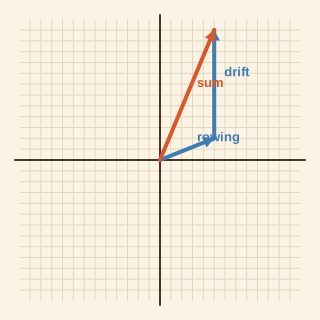
On walk 3 the rowing leg was angled, ⟨5, 2⟩. The components still add: ⟨5, 12⟩, and the tape read 13.
The tape only measures magnitude. The chalk squares give the components, and the components give the direction.
That is why the crew records both. A length alone is a scalar. A length and a direction is a vector.
- Read the question.
- Tap your answer.
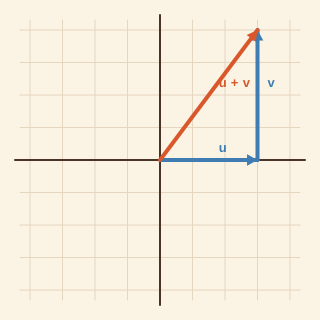 Walk 1: rowing ⟨3, 0⟩, then drift ⟨0, 4⟩. What is the sum vector?
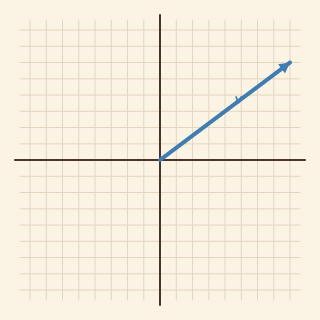 Walk 2 ended at ⟨8, 6⟩ from the start. What length should the tape read, in squares?
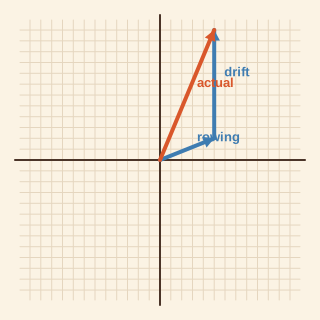 Walk 3: an angled rowing leg ⟨5, 2⟩, then drift ⟨0, 10⟩. What is the sum vector?
 Walk 3 ended at ⟨5, 12⟩. What length should the tape read, in squares?
| What the lab shows | True or false? |
|---|---|
| Walking the rowing leg and then the drift leg is adding vectors tip to tail. | ? |
| The tape from start to finish measures the direction of the sum. | ? |
| 64 + 36 = 100 | ? |
| Walking the drift leg first and the rowing leg second would end at a different point. | ? |
Careful lab work. Tomorrow a scalar stretches the rowing vector, and the crew aims upstream to land straight across.