Thursday
Thursday: Scalars and Aiming Upstream
"If I row twice as hard, my rowing vector doubles," Comet says, at the chalkboard in the shed.
"Twice ⟨4, 0⟩ is ⟨8, 0⟩," Wren says. "Both components times two. That is a scalar multiple."
"What about the drift? I want to land at the post, straight across."
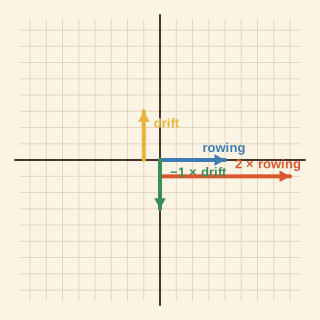
Nova projects the drift arrow, then flips it to point the other way. "Would you like a hint? Multiply by -1."
"Minus one flips the arrow," Wren says. "If I add ⟨0, -3⟩ to my rowing, the drift cancels."
Comet writes it out. "Row ⟨4, -3⟩. Add drift ⟨0, 3⟩. Path ⟨4, 0⟩. Straight across!"
"Aim upstream by exactly the drift," Wren says. "What do you notice about the length of your stroke?"
"Longer. √(16 + 9) is 5 squares of rowing to go 4 squares across."
Multiplying a vector by a scalar
A scalar is a plain number. Multiplying a vector by a scalar multiplies every component by that number.
2 × ⟨4, 0⟩ = ⟨8, 0⟩. The arrow points the same way and is twice as long.
½ × ⟨8, 0⟩ = ⟨4, 0⟩. The arrow points the same way and is half as long.
-1 × ⟨0, 3⟩ = ⟨0, -3⟩. The arrow is the same length and points the opposite way.
A positive scalar keeps the direction. A negative scalar reverses it. The magnitude is multiplied by the scalar's absolute value.
A solved problem: landing at the post
- The drift is ⟨0, 3⟩. Comet wants a path straight across, ⟨4, 0⟩.
- She needs rowing + drift = path, so rowing = path - drift.
- rowing = ⟨4, 0⟩ - ⟨0, 3⟩ = ⟨4, -3⟩. Aim 3 squares upstream for every 4 across.
- Check: ⟨4, -3⟩ + ⟨0, 3⟩ = ⟨4, 0⟩. The drift is cancelled.
- The rowing magnitude is √(16 + 9) = 5, more effort than the 4 straight across.
Why components add: the proof from the picture
Here is why tip to tail and adding components always agree. Read it first, then put it in order below.
- Let u = ⟨a, b⟩ and v = ⟨c, d⟩, both drawn from the origin.
- Slide v so its tail sits on the tip of u, the point (a, b).
- Moving c across and d up from (a, b) lands at (a + c, b + d).
- The sum arrow runs from the origin to (a + c, b + d).
- End point minus start point gives its components: ⟨a + c, b + d⟩.
- So u + v = ⟨a + c, b + d⟩. Tip to tail and adding components are the same thing.
- ?Slide v so its tail sits at the tip of u, the point (a, b)
- ?The sum arrow runs from the origin to (a + c, b + d)
- ?So u + v = ⟨a + c, b + d⟩
- ?From (a, b), going c across and d up lands at (a + c, b + d)
- ?End minus start gives components ⟨a + c, b + d⟩
- ?Let u = ⟨a, b⟩ and v = ⟨c, d⟩ from the origin
- Read the question.
- Tap your answer.
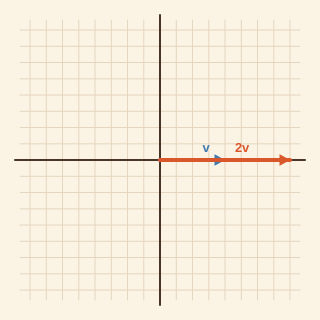 Comet rows twice as hard. What is 2 × ⟨4, 0⟩?
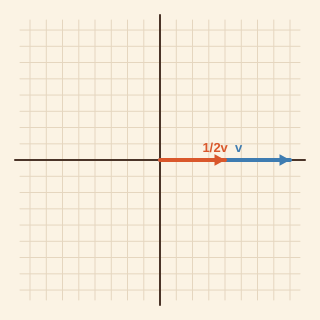 Half effort on the doubled stroke: what is ½ × ⟨8, 0⟩?
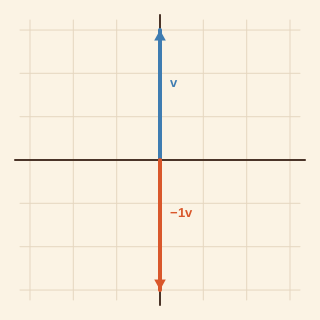 What is -1 × ⟨0, 3⟩, the vector that cancels the drift?
- Read the question.
- Tap your answer.
| Statement | True or false? |
|---|---|
| 2 × 4 = 8 | ? |
| Multiplying by ½ halves the magnitude and keeps the direction. | ? |
| Multiplying by -1 changes the magnitude. | ? |
| Rowing ⟨4, -3⟩ against drift ⟨0, 3⟩ gives a path of ⟨4, 0⟩. | ? |
| To cancel a drift you add the drift vector again. | ? |
Check it by adding. Then find the rowing magnitude and compare it with 6.
Sharp thinking. Tomorrow vectors leave the lake: paths across the lawn, a mixed review, and your log.