Tuesday
Tuesday: Adding Arrows Two Ways
Wren lays two pencils on the graph paper. One points across, four squares. One points up the shore, three.
"Tip to tail," he says, sliding the second pencil so it starts where the first one ends.
"Now draw from the start of the first to the tip of the second. That is the sum."
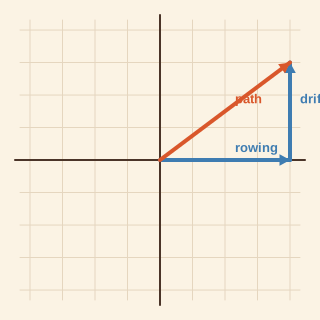
Comet draws it. "Four across, three up. ⟨4, 3⟩. Same as my real path."
"Or skip the pencils," Wren says. "Add the across parts, add the up parts."
Nova projects both methods side by side. "Would you like a hint? 4 + 0 and 0 + 3."
"Two ways, one answer," Comet says. "What do you notice about the picture?"
"It is the same right triangle as yesterday," Wren says. "The sum is always the long side."
Way one: tip to tail
Draw the first arrow. Draw the second arrow starting at the first arrow's tip.
The sum is the arrow from the first arrow's tail to the second arrow's tip. That is the resultant.
The picture shows why rowing plus drift is the path. The boat does both moves at once, but the arrows add the same.
Way two: components
Add the x components to get the new x component. Add the y components to get the new y component.
⟨4, 0⟩ + ⟨0, 3⟩ = ⟨4 + 0, 0 + 3⟩ = ⟨4, 3⟩.
Subtraction works the same way, component by component. u - v means u + (-v): flip both components of v, then add.
The drift is what the water added: path - rowing = ⟨4, 3⟩ - ⟨4, 0⟩ = ⟨0, 3⟩.
Three crossings from Nova's log
Each row is one of the crew's crossings. Rowing plus drift gives the path every time, in squares on the grid.
| Crossing | Rowing | Drift | Path (sum) | |Path| |
|---|---|---|---|---|
| Monday | ⟨4, 0⟩ | ⟨0, 3⟩ | ⟨4, 3⟩ | 5 |
| Second try | ⟨6, 0⟩ | ⟨0, 8⟩ | ⟨6, 8⟩ | 10 |
| Angled start | ⟨5, 2⟩ | ⟨0, 10⟩ | ⟨5, 12⟩ | 13 |
- Read the question.
- Tap your answer.
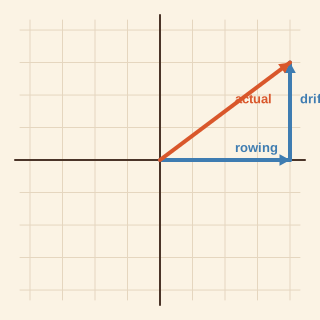 The crew rows ⟨4, 0⟩ and the water drifts them ⟨0, 3⟩ (squares from Nova's log). What is the actual path vector?
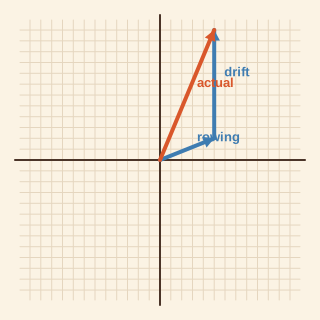 On the angled start the rowing vector was ⟨5, 2⟩ and the drift was ⟨0, 10⟩. What is the path vector?
- ?Draw the first arrow from its tail to its tip
- ?Check by adding the components of the two arrows
- ?Slide the second arrow so its tail sits on the first arrow's tip
- ?Read the new arrow's components: across, then up
- ?Draw a new arrow from the first tail to the second tip
| Statement | True or false? |
|---|---|
| To add vectors tip to tail, the second arrow starts where the first one ends. | ? |
| 4 + 0 = 4 | ? |
| Adding components in a different order changes the sum. | ? |
| u - v is the same as u + (-v). | ? |
| 3 - 0 = 3 | ? |
Then add the components. Circle the two answers in your log and check they match.
Excellent. Tomorrow the chalk comes out and you walk a vector sum across the lawn in the Boathouse Lab.