Monday
Monday: An Arrow With a Size and a Direction
Comet pushes off from the dock in her life vest, aiming straight at the far post. A grown-up watches from the dock.
She rows hard and steady. When the bow touches the far shore, she is well to the left of the post.
"I aimed straight," she calls back. "The water carried me sideways."
Wren marks the dock, the post and the landing spot on graph paper. "What do you notice? Your whole trip is one arrow."
Nova projects two arrows on the water, a long one across and a short one sideways. "Would you like a hint? Two arrows, one trip."
"Rowing plus drift," Wren says. "Add the two arrows and you get the real path."
"Then let us measure all three," Comet says. "What can we make of them?"

What a vector is
Some quantities are just a size: a lap time, a plank length, a count of buoys. Those are scalars.
A vector has a size and a direction. "Four squares east and three squares north" is a vector. "Five squares" alone is not.
We draw a vector as an arrow. The arrow's length is its magnitude, and the way it points is its direction.
We name a vector with a bold letter, v, or with a small arrow over the letter. Its magnitude is written |v|.
Two arrows that are the same length and point the same way are the same vector, wherever they start.
Components from two points
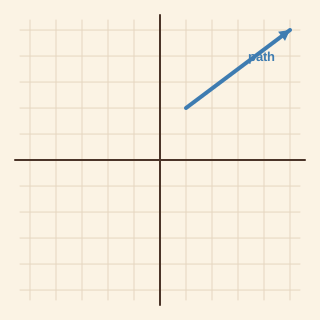
On Wren's grid the dock is at (1, 2) and Comet landed at (5, 5). Each square is one unit in Nova's log.
The vector from the dock to the landing is end point minus start point, one coordinate at a time.
Across: 5 - 1 = 4. Up: 5 - 2 = 3. So the path vector is ⟨4, 3⟩.
We write components in angle brackets, ⟨x, y⟩, so no one mistakes a vector for a point.
A solved problem to study
- Comet's path vector is ⟨4, 3⟩: 4 squares across and 3 squares up the shore.
- The arrow, its across part and its up part make a right triangle. The arrow is the hypotenuse.
- By the Pythagorean theorem, |path|² = 4² + 3² = 16 + 9 = 25.
- So |path| = √25 = 5. Comet traveled 5 squares, not the 4 she aimed for.
- Her rowing vector was ⟨4, 0⟩, magnitude 4. The drift vector was ⟨0, 3⟩, magnitude 3.
- Check: ⟨4, 0⟩ + ⟨0, 3⟩ = ⟨4, 3⟩. Rowing plus drift is the path.
Notice the order. Components first, from the two points. Magnitude second, from the components.
Every number here is the crew's own reading from Nova's log, not a fact about any real lake.
- Read the question.
- Tap your answer.
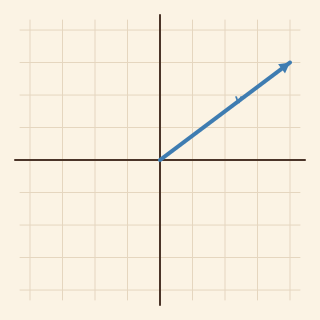 The dock is at (1, 2) and Comet landed at (5, 5). What are the components of her path vector?
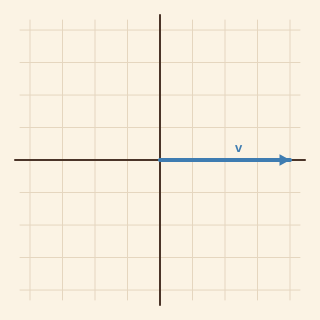 Comet aimed straight across from (0, 0) toward (4, 0). What are the components of her rowing vector?What is the magnitude of the path vector ⟨4, 3⟩, in squares?
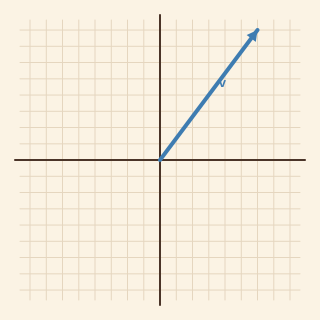 A longer crossing in the log has path vector ⟨6, 8⟩. What is its magnitude, in squares?
| Statement | True or false? |
|---|---|
| A vector has both a magnitude and a direction. | ? |
| A lap time of 48 seconds is a vector. | ? |
| 5 - 1 = 4 | ? |
| Components are start point minus end point. | ? |
| 16 + 9 = 25 | ? |
Count across and count up to get the components. Then use the Pythagorean theorem for the length.
Strong start. Tomorrow the two arrows get added, tip to tail and by components, and the answers agree.