Friday
Friday: Vectors Everywhere
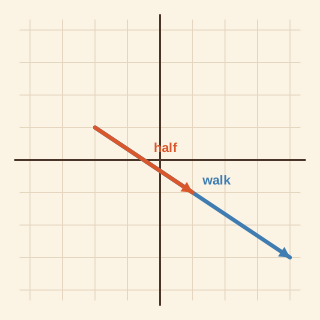
Friday the crew walks the lawn with the log open. Wren has drawn the lawn on a grid.
"Shed door at (-2, 1). Dock steps at (4, -3)," he says. "What is the walk, as a vector?"
Comet subtracts. "4 minus -2 is 6. -3 minus 1 is -4. ⟨6, -4⟩."
"Halfway there is half the vector," Wren says. "⟨3, -2⟩. That is where the buoy crate sits."
Nova projects an arrow across the lawn, then slides it to start at the shed door. "Would you like a hint? Same arrow, new start."
"A vector does not care where it starts," Comet says. "Only how far and which way."
"That is what makes it useful," Wren says. "A walk, a row, a drift, a push. Same math."
Where vectors show up
- A walk across the lawn: how far east and how far north, from any door to any dock.
- A rowing stroke and a drift: two vectors acting at once, adding to one path.
- A push on the winch rope: how hard and in which direction. Two crew pulling at an angle add tip to tail.
- A route with several legs: add all the legs, in any order, and the resultant is the whole trip.
Displacement and velocity
A displacement vector says where something ended up compared with where it started. The lawn walk is one.
A velocity vector says how fast and in which direction, in units per second from the crew's stopwatch.
If Comet's rowing velocity is ⟨4, 0⟩ squares per minute and the drift is ⟨0, 3⟩, her actual velocity is ⟨4, 3⟩.
Her speed, the magnitude, is 5 squares per minute. Speed is a scalar; velocity is a vector.
Every reading here is the crew's own number from Nova's log, not a fact about any real boat or lake.
Mixed review
- Read the question.
- Tap your answer.
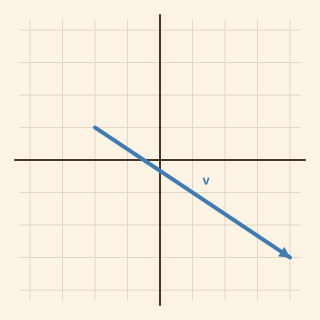 The shed door is at (-2, 1) and the dock steps at (4, -3). What is the walk vector?
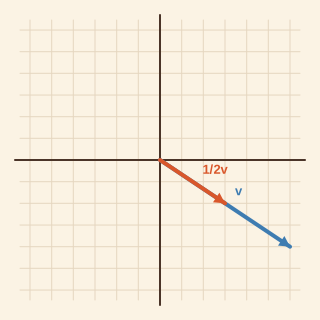 Halfway along the walk ⟨6, -4⟩ is ½ × ⟨6, -4⟩. What vector is that?
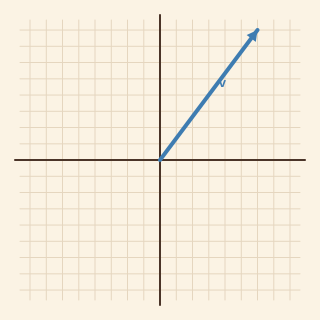 A route in the log has resultant ⟨6, 8⟩. What is its magnitude?
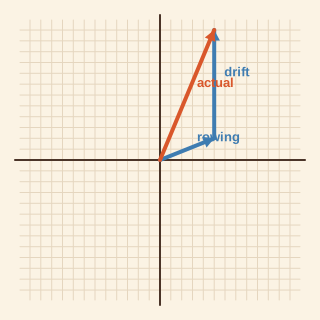 The crew rows with velocity ⟨5, 2⟩ and the water drifts them by ⟨0, 10⟩ (squares per minute in the log). What is the actual velocity?
- Read the question.
- Tap your answer.
| Statement | True or false? |
|---|---|
| Speed is a scalar and velocity is a vector. | ? |
| A vector changes when you slide it to a new starting point. | ? |
| 4 - (-2) = 6 | ? |
| -3 - 1 = -4 | ? |
| Half of ⟨6, -4⟩ is ⟨3, -4⟩. | ? |
Find its magnitude. Then write the vector for walking back the other way.
Fine week's work. Tomorrow is Dock Day: the chalk walk comes home to the family.