Week 10 · Vectors
Dock Day
Dock Day: the family chalk walk
// Rowing across the drift
⏱ about 20 min
Dock Day: The Family Chalk Walk
Saturday the chalk and the tape come home. Comet marks a start point on the driveway.
"Everyone gets a rowing leg and a drift leg," she says. "Walk both, then we tape the straight line home."
Someone walks ⟨3, 0⟩ and then ⟨0, 4⟩. The tape reads 5.
"Before the tape, say the magnitude," Wren says. "Square, square, add, root."
Nova dims her light to a hint. "Would you like a hint? The two legs are the two short sides."
"Now a trick," Comet says. "Walk a leg, then walk its negative. Where do you end up?"
"Right back at the start," comes the answer. "The vectors cancel."
"That is how a rower aims upstream," Wren says. "Add the drift's negative and the drift is gone."
- A vector has a magnitude and a direction. Its components are end point minus start point.
- The magnitude of ⟨x, y⟩ is the square root of x² + y², by the Pythagorean theorem.
- Vectors add tip to tail or component by component, and the two ways always agree.
- A scalar multiplies every component: it stretches, shrinks or, when negative, flips the arrow.
- Rowing plus drift is the path. To land straight across, row the path minus the drift.
◇ FAMILY CHALK WALK
Chalk a grid of big steps on dry pavement, or lay string lines on the lawn. Mark a start point.
Each person draws a rowing card and a drift card with whole components. Walk the first, then the second.
Before taping, everyone says the sum vector and its magnitude. Then tape the straight line and compare.
Finish with the cancel trick: walk a vector, then its negative. Trade cards so everyone walks and everyone checks.
Each person draws a rowing card and a drift card with whole components. Walk the first, then the second.
Before taping, everyone says the sum vector and its magnitude. Then tape the straight line and compare.
Finish with the cancel trick: walk a vector, then its negative. Trade cards so everyone walks and everyone checks.
For a grown-up
This is a walking and measuring activity. Stay on flat, dry ground away from any road or water.
A tape reading a step off is a good moment: ask which leg was walked a little long.
The drift and rowing numbers are the family's own game, not facts about any real water.
A tape reading a step off is a good moment: ask which leg was walked a little long.
The drift and rowing numbers are the family's own game, not facts about any real water.
DOCK DAY CHECK
- Read the question.
- Tap your answer.
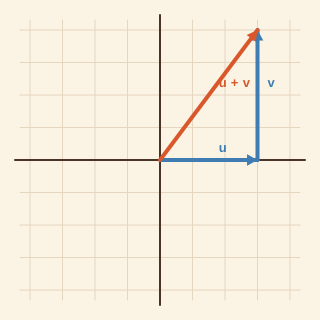 A family card pair: rowing ⟨3, 0⟩, then drift ⟨0, 4⟩. What is the sum vector?
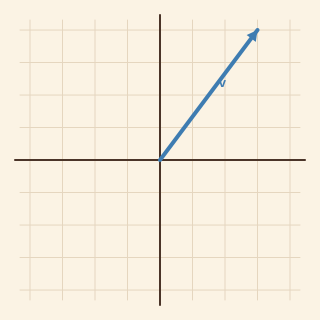 The walker ends at ⟨3, 4⟩ from the start. What should the tape read?
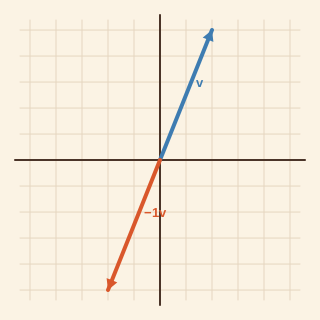 A walker walks ⟨2, 5⟩ and then wants to walk straight back to the start. What is -1 × ⟨2, 5⟩?
A walker goes ⟨6, 8⟩ from the start. How many squares does the tape read? Type the number.
Square both components, add them, and take the square root.
WHY THIS EXERCISEEvery card pair ends the same way: components from the walk, magnitude from the Pythagorean theorem.
Draw the family grid with one walker's two legs, the sum arrow and the tape reading written beside it.