Wednesday
Wednesday: Boathouse Lab, the Average Lap
"Six laps around the buoy," Comet says, pulling her life vest tight. "Wren, click at the post each time I pass."
Wren reads the stopwatch as she rows. "80 seconds for lap one. 130 total after two. 180 after three."
"The first lap has a slow start," Comet calls. "About 30 seconds to get moving, then 50 seconds a lap."
"So the total is 50n + 30," Wren says. "And the average per lap is that over n. What do you notice?"
Nova projects the averages: 80, 65, 60, 57.5. "Would you like a hint? Where does the average head?"
"Toward 50," Comet says. "The slow start gets spread thinner every lap. It never disappears, so the average never hits 50."
A grown-up watches from the dock the whole time, and the rowboat stays inside the buoys.
What you need
- A stopwatch or kitchen timer, a clear path to walk around (a table or a yard), and your Boathouse Log.
- A partner to click the stopwatch each time you pass the start.
- Graph paper for the average-lap curve.
Near any water a grown-up is present and life vests are on. Rowing is for the crew with a grown-up on the dock.
Nothing heavy is lifted alone, and a grown-up handles any ladder.
Run the lab
- Mark a start line. Count down from three, start the stopwatch and begin walking your laps.
- Have your partner call out the total time each time you cross the start. Record it for six laps.
- For each row, divide the total time by the lap number. That is your average seconds per lap.
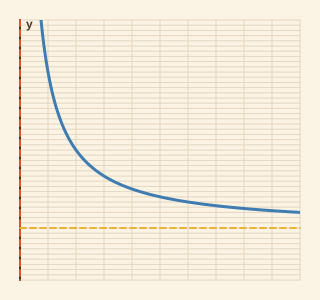
- Plot lap number across and average per lap up. Draw a dashed line at the value the averages approach.
- Fit a rule: total ≈ (seconds per lap) × n + (start delay). Write it in your log.
- Write your average rule as a rational function and name its horizontal asymptote.
The crew's stopwatch log
These are Comet's six laps from Nova's log, the crew's own made-up readings. Your walking laps will give different numbers and the same shape.
| Lap n | Total seconds | Average per lap | Gap above 50 |
|---|---|---|---|
| 1 | 80 | 80 | 30 |
| 2 | 130 | 65 | 15 |
| 3 | 180 | 60 | 10 |
| 4 | 230 | 57.5 | 7.5 |
| 5 | 280 | 56 | 6 |
| 6 | 330 | 55 | 5 |
The average is a rational function
Total seconds after n laps: 50n + 30. Average per lap: (50n + 30)/n, a polynomial over a polynomial.
Split it: (50n + 30)/n = 50 + 30/n. The 30/n is the slow start shared across n laps. It shrinks toward 0.
So the average falls toward 50 and never reaches it. The line y = 50 is the wall, this time approached from above.
Degrees match, top and bottom, so the horizontal asymptote is the ratio of leading coefficients: 50/1 = 50.
The function is not allowed at n = 0. Zero laps have no average, which is exactly what the rule says.
- Read the question.
- Tap your answer.
The crew's average rule is y = (50x + 30)/x. What is its horizontal asymptote, the wall?Where is the vertical asymptote of the average rule y = (50x + 30)/x?| What the lab shows | True or false? |
|---|---|
| The average per lap falls toward 50 but never reaches it. | ? |
| 330 ÷ 6 = 55 | ? |
| The average rule has a value at n = 0. | ? |
| (50n + 30)/n is the same as 50 + 30/n. | ? |
| The wall for the average is approached from below, like the laps model. | ? |
Careful lab work. Tomorrow a harder set, and a proof of why the wall is always the ratio of the leading coefficients.