Thursday
Thursday: Why the Wall Is Where It Is
"Two walls this week," Wren says. "The laps model climbed to 8. The average fell to 50. Both were top coefficient over bottom coefficient."
"Is that always true when the degrees match?" Comet asks. "Or did we get lucky twice?"
Nova projects y = (ax + b)/(cx + d). "Would you like a hint? Monday's trick, divide top and bottom by x, works for letters too."
"a + b/x over c + d/x," Wren says. "As x grows, b/x and d/x shrink to nothing. What is left is a over c."
"So the wall is always a/c," Comet says. "Say it as a proof and I will believe it."
"Then a harder set," Wren says. "Holes, two asymptotes, and a function with no wall at all."
"And one answer that makes no sense," Comet adds. "A negative week. We throw those out."
Why y = (ax + b)/(cx + d) approaches a/c
Here is the reason in six steps, for c not 0. Read it first, then put it in order below.
- Start with y = (ax + b)/(cx + d) and take x very large, far from any vertical asymptote.
- Divide every term on the top and the bottom by x. The value of y does not change.
- The top becomes a + b/x. The bottom becomes c + d/x.
- As x grows without bound, b/x and d/x both shrink toward 0.
- So the top approaches a and the bottom approaches c.
- Therefore y approaches a/c. The line y = a/c is the horizontal asymptote.
Check it with the laps model (8x)/(x + 2). Here a = 8 and c = 1, so the wall is y = 8.
Check it with the average (50x + 30)/x: a = 50 and c = 1, so the wall is y = 50.
The same idea with higher degrees: when the bottom's degree is higher, dividing by its top power leaves 0 on top. When the top's is higher, y keeps growing.
- ?b/x and d/x shrink toward 0 as x grows
- ?Start with y = (ax + b)/(cx + d) and take x very large
- ?The top is a + b/x and the bottom is c + d/x
- ?Divide every term on the top and the bottom by x
- ?The top approaches a and the bottom approaches c
- ?So y approaches a/c, the horizontal asymptote
A harder set
(x² - 2x - 3)/(x² - 9) has a hole at x = 3. Its vertical asymptote is x = -3 and its wall is y = 1.
(x² + 1)/(x - 2) has a vertical asymptote at x = 2. The top's degree is higher, so there is no wall.
(x - 1)/(x² - x - 6) has two vertical asymptotes. The bottom's degree is higher, so its wall is y = 0.
- Read the question.
- Tap your answer.
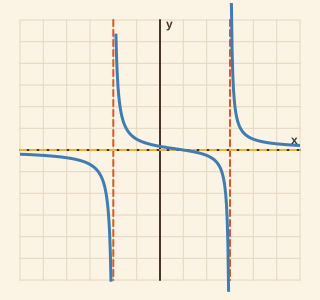 Where are the vertical asymptotes of y = (x - 1)/(x² - x - 6)?What is the horizontal asymptote of y = (x - 1)/(x² - x - 6)?
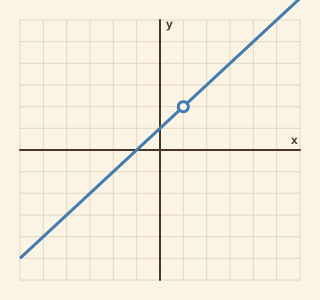 (x² - 1)/(x - 1) looks like it has a wall at x = 1. Where is its hole instead?
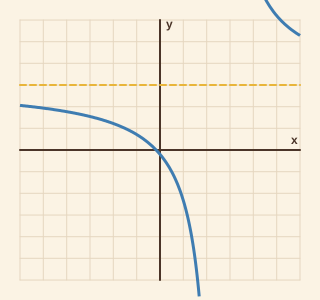 Use the proof: what is the horizontal asymptote of y = (6x + 1)/(2x - 5)?
Which answer makes sense?
Solving (8x)/(x + 2) = 6 gives x = 6, a week count that makes sense. Solving (8x)/(x + 2) = 10 gives x = -10.
A negative week is true algebra and false rowing. The model only means something for x at least 0. Say so when it happens.
Values at or above the wall, like 8 or 10 laps per hour, are never reached. An equation set equal to them has no sensible answer.
- Read the question.
- Tap your answer.
| Statement | True or false? |
|---|---|
| For y = (ax + b)/(cx + d), the horizontal asymptote is y = a/c. | ? |
| Dividing the top and the bottom by x changes the value of y. | ? |
| 8 × 6 ÷ (6 + 2) = 6 | ? |
| A rational function with a higher degree on top has no horizontal asymptote. | ? |
| A negative week from the laps model is a sensible answer. | ? |
Clear reasoning. Tomorrow the dock schedule, where new rules are built from the ones the crew already has.