Tuesday
Tuesday: Zeros, Asymptotes and Holes
"Four functions on the wall sheet," Wren says. "(2x + 1)/(x - 3), (3x)/(x² - 4), (x² - 2x - 3)/(x² - 9) and (x² + 1)/(x - 2)."
"Where is each one not allowed?" Comet asks.
"Set each bottom to 0," Wren says. "The first is forbidden at x = 3. The second at x = -2, x = 2."
"The third bottom is 0 at x = 3 and x = -3," Comet says. "But the top is 0 at x = 3 too. What do you notice?"
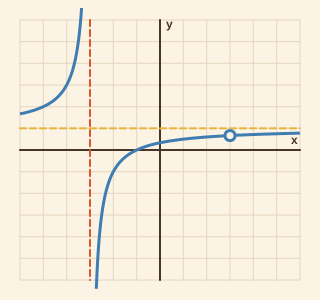
Nova projects the graph with one tiny open circle. "Would you like a hint? A shared zero cancels."
"So x = 3 is a hole, not a wall," Wren says. "And x = -3 is the vertical asymptote."
"Two ways to find all this," Comet says. "Factor first, or plug in numbers near the trouble."
Way one: factor and read
- Factor the top and the bottom completely.
- Cancel any factor that appears in both. Each cancelled factor marks a hole at its zero.
- Zeros of the graph: where a remaining top factor is 0.
- Vertical asymptotes: where a remaining bottom factor is 0.
- Horizontal asymptote: compare degrees. Bottom higher gives y = 0. Equal gives the ratio of leading coefficients. Top higher gives none.
Way two: plug in and watch
Near a vertical asymptote, values blow up. For (2x + 1)/(x - 3) at x = 2.9 the bottom is -0.1, so y is a large negative number.
Near a hole, values settle to one number but the point itself is missing. Plugging in x = 3 for the third function gives 0/0, no value.
Far out, plug in x = 1,000. Whatever y is close to, that is the horizontal asymptote.
Factoring is faster. Plugging in is the check. The crew does both when the two disagree.
The wall sheet, read
| Function | Zeros | Vertical asymptotes | Hole | Horizontal asymptote |
|---|---|---|---|---|
| (2x + 1)/(x - 3) | none | x = 3 | none | y = 2 |
| (3x)/(x² - 4) | x = 0 | x = -2, x = 2 | none | y = 0 |
| (x² - 2x - 3)/(x² - 9) | x = -1 | x = -3 | x = 3 | y = 1 |
| (x² + 1)/(x - 2) | none | x = 2 | none | none |
- Read the question.
- Tap your answer.
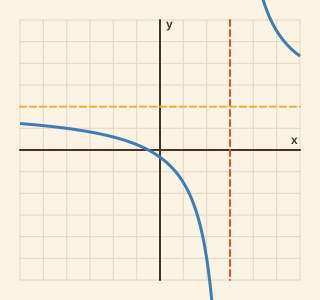 Where are the vertical asymptotes of y = (2x + 1)/(x - 3)?
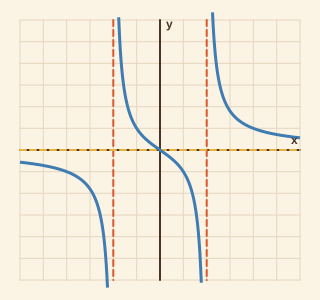 Where are the vertical asymptotes of y = (3x)/(x² - 4)?Where does the graph of y = (x² - 2x - 3)/(x² - 9) have a hole?(x² - 2x - 3)/(x² - 9) has a hole at x = 3. Where is its vertical asymptote?
- Read the question.
- Tap your answer.
What is the horizontal asymptote of y = (2x + 1)/(x - 3)?What is the horizontal asymptote of y = (3x)/(x² - 4)?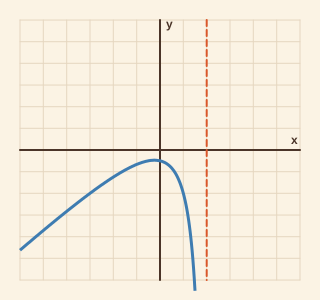 What is the horizontal asymptote of y = (x² + 1)/(x - 2)?
- Read the question.
- Tap your answer.
| Statement | True or false? |
|---|---|
| A vertical asymptote sits where the bottom is 0 and the top is not. | ? |
| A hole sits where the top and the bottom share a zero. | ? |
| (x² + 1)/(x - 2) has a horizontal asymptote. | ? |
| When the degrees match, the horizontal asymptote is the ratio of the leading coefficients. | ? |
| (2x + 1)/(x - 3) crosses its vertical asymptote at x = 3. | ? |
Sharp reading. Tomorrow is Boathouse Lab: a stopwatch, six laps and an average that falls toward its own wall.