Friday
Friday: Building a Rule From Two Others
"The dock schedule," Comet says, pinning a card. "In session x the crew rows L(x) = 2x + 1 laps. Each lap takes M(x) = x + 4 minutes."
"So the session takes laps times minutes per lap," Wren says. "A new rule, L × M. Try session 3."
"L(3) is 7 laps, M(3) is 7 minutes," Comet says. "So 49 minutes. That is a long session."
"Another card," Wren says. "b(x) = x + 2 boats after x new crews join. Each boat needs R(b) = 2x + 4 ropes."
Nova projects an arrow from x to b to R. "Would you like a hint? Feed one rule into the other."
"R(b(x))," Comet says. "With x = 3: b(3) = 5, then R(5) = 14 ropes. Composing, inside first."
"Add, multiply, compose," Wren says. "Three ways to build the rule you need from two you have."
Three ways to build a rule
- Add: (f + g)(x) = f(x) + g(x). Two crews' lap counts added give the total laps.
- Multiply: (f × g)(x) = f(x) × g(x). Laps times minutes per lap gives session minutes.
- Compose: (f ∘ g)(x) = f(g(x)). Work from the inside out: crews to boats, then boats to ropes.
- Divide too: (f ÷ g)(x) = f(x)/g(x), a rational function, as long as g(x) is not 0.
The dock schedule cards
| Rule | Built from | At x = 3 |
|---|---|---|
| L(x) = 2x + 1 laps | given | 7 |
| M(x) = x + 4 minutes per lap | given | 7 |
| (L × M)(x) session minutes | multiply | 49 |
| b(x) = x + 2 boats | given | 5 |
| R(b) = 2x + 4 ropes | given, b boats | 14 |
| R(b(x)) ropes for x new crews | compose | 14 |
Order matters in composing. R(b(x)) feeds crews into boats, then boats into ropes. b(R(x)) would feed ropes into boats, which means nothing here.
Check a built rule with one number. If (L × M)(3) does not match L(3) times M(3), something was built wrong.
- Read the question.
- Tap your answer.
- Read the question.
- Tap your answer.
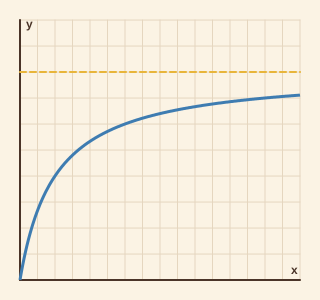 One more look at the laps model y = (8x)/(x + 2). What is its horizontal asymptote?
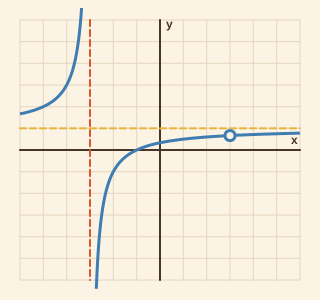 Where does the graph of y = (x² - 2x - 3)/(x² - 9) have a hole?
| Statement | True or false? |
|---|---|
| (f × g)(x) means f(x) times g(x). | ? |
| f(g(x)) and g(f(x)) are always the same. | ? |
| 7 × 7 = 49 | ? |
| Dividing two polynomial rules gives a rational function. | ? |
| To find f(g(3)), start by computing f(3). | ? |
Where the crew used this week's math
| Question | Tool | Answer |
|---|---|---|
| Laps per hour after 6 weeks | evaluate (8x)/(x + 2) | 6 |
| The wall for the laps model | ratio of leading coefficients | y = 8 |
| Average lap after 6 laps | evaluate (50x + 30)/x | 55 |
| Session 3 minutes | multiply L and M | 49 |
| Ropes for 3 new crews | compose R and b | 14 |
A full week of walls and built rules. Tomorrow is Dock Day: show your family an average that never reaches its wall.