Wednesday
Wednesday: Build Lab: Draw It to Scale
Raven tapes a sheet of grid paper flat on the Blueprint Table. "Build Lab. Three things, measured and drawn to scale."
"The table top first," Rocket says, already pulling out the tape measure. "One fifty by ninety."
"Measure twice," Raven says. "What do you notice if the tape sags in the middle?"
"It reads too long," Rocket admits, and pulls it straight.
Nova hovers over the grid paper, her light counting squares. "Ten real centimeters for every square," she says. "Does the table fit?"
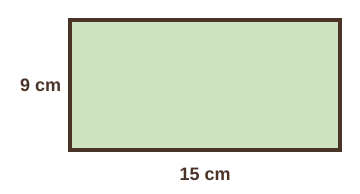
"Fifteen squares by nine," Rocket says. "Easy." He draws the rectangle and labels both real lengths.
"Doormat next," Raven says, "then the toolbox lid."
Nova hums. "Same scale for all three, so the drawings compare."
Your mission
Measure three flat, rectangular things. Draw all three at the same scale on grid paper, and label every real length.
- A tape measure or a long ruler.
- Grid paper with 1 cm squares, taped flat to the table.
- A pencil, an eraser and your Blueprint Book.
- Three rectangles to measure: a table top, a doormat, a book, a tray or a box lid.
Tape the grid paper down so it does not slide. Shoes on in the garage.
Measure things at floor or table height. Never stand on a chair to reach something high.
- Measure the length and width of each thing twice. Write the numbers in a table.
- Pick one scale that lets the biggest thing fit the paper, such as 1 cm to 10 cm.
- Divide each real length by the scale number to get the drawn length.
- Draw each rectangle on the grid paper. Label the real lengths beside each side.
- Check one drawn length with the ruler. Multiply it back by the scale number.
The crew's lab table
The crew's own measurements at the Blueprint Table, drawn at 1 cm to 10 cm. Nothing here is a standard size.
| Thing | Real length (cm) | Real width (cm) | Drawn length (cm) | Drawn width (cm) |
|---|---|---|---|---|
| Table top | 150 | 90 | 15 | 9 |
| Doormat | 60 | 40 | 6 | 4 |
| Toolbox lid | 45 | 25 | 4.5 | 2.5 |
The table top became 15 cm by 9 cm. The toolbox lid became 4.5 cm by 2.5 cm, a fraction edge.
All three drawings share one scale, so the table top really does look bigger than the doormat on the page.
- Read the question.
- Tap your answer.
| What the lab shows | True or false? |
|---|---|
| 150 ÷ 10 = 15 | ? |
| 45 ÷ 10 = 4.5 | ? |
| Three drawings at the same scale can be compared by size. | ? |
| A sagging tape measure reads too short. | ? |
Three things on one page, to scale. Tomorrow the crew finishes the garage plan and compares areas.