Tuesday
Tuesday: Choosing a Scale
"I want the garage bigger," Rocket says, holding up a huge sheet of poster paper. "This is 60 centimeters wide."
"Then pick a smaller scale number," Raven says. "What do you notice when 1 cm stands for 20 cm instead of 50?"
Rocket works it out. "400 divided by 20. Twenty centimeters. The drawing grows."
"And for the tiny notebook page?" Raven asks.
"1 cm to 100 cm," Rocket says. "Four centimeters. It shrinks."
Nova hovers over the three sheets, her light measuring each one. "The scale fits the paper," she says. "Not the other way."
Raven writes three columns in the Blueprint Book, one for each scale. "Same garage, three sizes."
Nova hums. "Same shape every time."
One wall, three scales
| Scale | 1 cm stands for | Long wall, 400 cm, on paper |
|---|---|---|
| 1 cm to 20 cm | 20 cm | 20 cm |
| 1 cm to 50 cm | 50 cm | 8 cm |
| 1 cm to 100 cm | 100 cm | 4 cm |
A smaller scale number makes a bigger drawing: at 1 cm to 20 cm the wall is 20 cm long on paper.
A bigger scale number makes a smaller drawing: at 1 cm to 100 cm the same wall is 4 cm.
Choose the scale so the biggest real length fits the paper with room for labels.
Finding a scale from the drawing
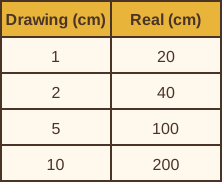
If a 3 cm line stands for the 150 cm table, the scale is 150 ÷ 3 = 50. So 1 cm to 50 cm.
Divide a real length by its drawn length to find what 1 cm stands for. Any matching pair works.
- Measure the longest real length.
- Measure the paper.
- Divide the real length by the paper width. Round up to a handy scale number: 10, 20, 25, 50 or 100.
- Check: real length divided by the scale number must fit the paper.
- Read the question.
- Tap your answer.
- Read the question.
- Tap your answer.
- Read the question.
- Tap your answer.
- ?Measure the paper you will draw on.
- ?Divide every real length by the scale number and draw.
- ?Divide the real length by the paper width and round up to a handy scale number.
- ?Measure the longest real length with the tape measure.
Three scales, one garage. Tomorrow is Build Lab: measure, choose a scale and draw for real.