Monday
Monday: One Centimeter Stands for Fifty
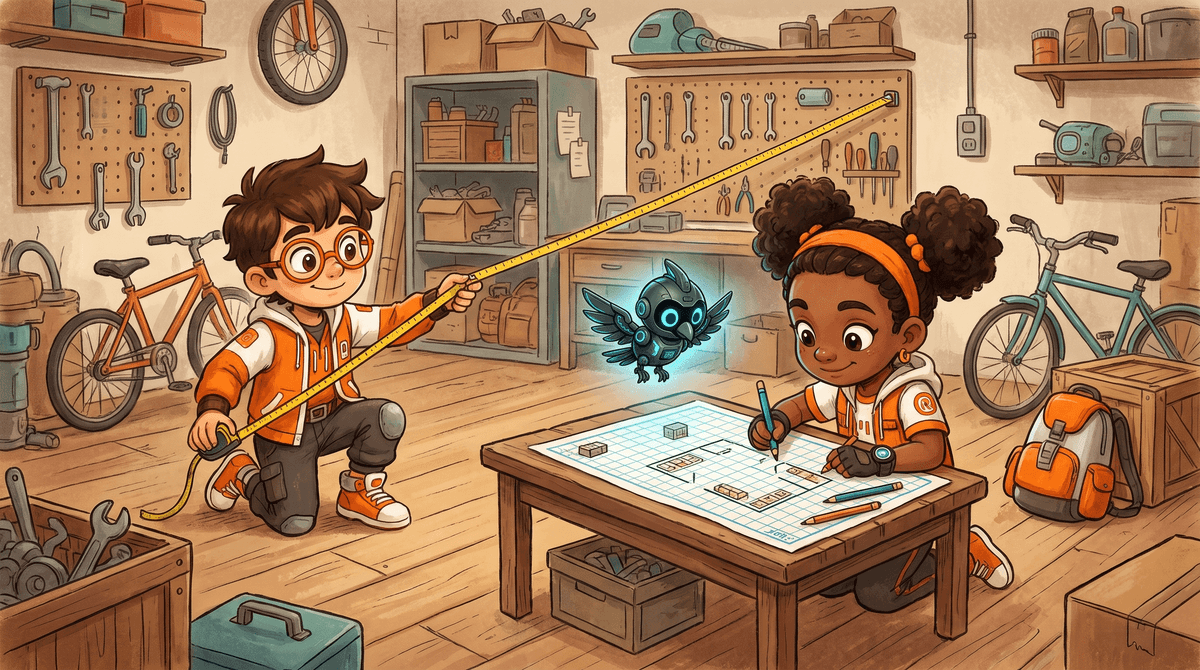
Rocket drags the tape measure across the garage floor. "Four hundred centimeters! The paper is twenty centimeters wide."
"So the garage will not fit," Raven says, "unless we shrink it. What do you notice about a map?"
"Everything is tiny," Rocket says, "but the shapes are right."
Nova hovers over the Blueprint Book, her light drawing a short line. "Let one centimeter on paper stand for many centimeters on the floor."
"Fifty," Raven decides. "One centimeter for every fifty. Then 400 centimeters is 8 centimeters."
Rocket measures the other wall. "Three hundred. So that is 6 centimeters on paper."
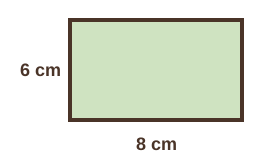
He draws a rectangle 8 by 6. "The garage. On one page."
Nova hums. "Now every wall has two lengths: one on the floor, one on the page."
What a scale means
A scale drawing keeps the shape of the real thing and shrinks every length by the same amount.
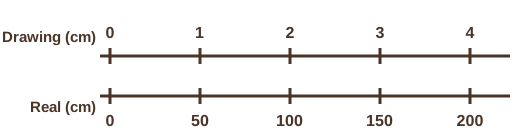
The crew's scale is 1 cm to 50 cm: every centimeter on the page stands for 50 centimeters on the floor.
The long wall is 400 cm. On the page it is 400 ÷ 50 = 8 cm.
The short wall is 300 cm, so 300 ÷ 50 = 6 cm on the page.
Two directions
Real to drawing: divide by the scale number. 150 cm of table becomes 150 ÷ 50 = 3 cm on paper.
Drawing to real: multiply by the scale number. A 2 cm window on paper is 2 × 50 = 100 cm on the wall.
The scale number is the scale factor from the page to the floor. Going back to the page, you divide by it.
- Read the question.
- Tap your answer.
- Read the question.
- Tap your answer.
| Statement | True or false? |
|---|---|
| 400 ÷ 50 = 8 | ? |
| 6 × 50 = 300 | ? |
| A scale drawing changes the shape of the real thing. | ? |
| At 1 cm to 50 cm, you divide a real length by 50 to draw it. | ? |
Write the real lengths and the drawn lengths side by side in your Blueprint Book.
Measure things you can reach from the floor. Shoes on in the garage.
The garage fits on a page. Tomorrow you pick scales for different sheets of paper.