Tuesday
Tuesday: Graphing by Hand
Wren hands Comet a sheet of graph paper. "Two functions, two ways. You take the table, I take the vertex form."
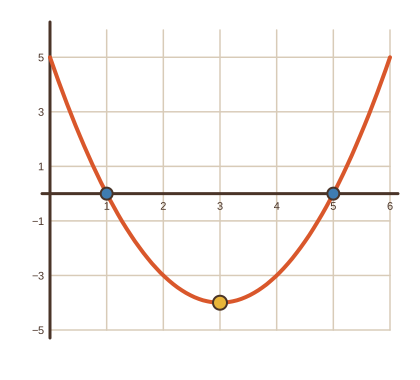
Comet writes y = x² - 6x + 5 and fills a table from x = 0 to 6. "0, 5. 1, 0. 2, -3. 3, -4. 4, -3. 5, 0. 6, 5."
"Plot them and join them," Wren says. "What do you notice?"
"The bottom is at (3, -4). It crosses at 1 and 5." Comet draws a smooth U.
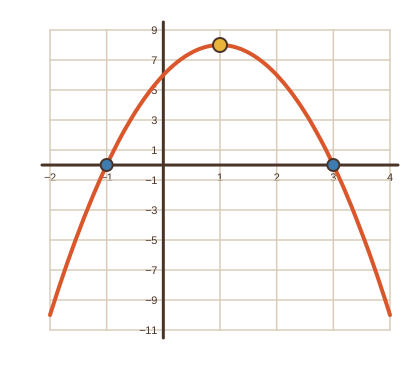
Wren writes y = -2(x - 1)² + 8. "Mine shows the vertex right away. (1, 8). Opening down because of the -2."
Nova projects both graphs side by side. "Would you like a hint? Complete the square on Comet's and compare."
"x² - 6x + 9 is (x - 3)², so mine is (x - 3)² - 4," Comet says. "The vertex was hiding in there."
Way one: a table of values
- Pick x values around the vertex. For y = x² - 6x + 5, use x = 0 to 6.
- Work out y for each x and write the pairs in a table.
- Plot the points on graph paper with labeled axes and scales.
- Join them in a smooth curve, never straight segments.
- Mark the vertex, the axis of symmetry and the intercepts.
| x | 0 | 1 | 2 | 3 | 4 | 5 | 6 |
|---|---|---|---|---|---|---|---|
| y | 5 | 0 | -3 | -4 | -3 | 0 | 5 |
Way two: vertex form
Vertex form is y = a(x - h)² + k. The vertex is (h, k), read straight off the rule. The sign of a says which way it opens.
Wren's y = -2(x - 1)² + 8 has vertex (1, 8) and opens down. Expanded, it is y = -2x² + 4x + 6.
Its x-intercepts solve -2x² + 4x + 6 = 0: x = -1 and x = 3.
Completing the square finds the vertex
- Start with y = x² - 6x + 5.
- Take half of -6, which is -3, and square it: 9.
- Add and subtract 9: y = (x² - 6x + 9) - 9 + 5.
- Write the square: y = (x - 3)² - 4.
- Read the vertex: (3, -4). It matches the table.
Compare the two ways. A table shows the whole shape but can miss the exact vertex. Vertex form gives the vertex at once.
Standard form y = ax² + bx + c shows the y-intercept, c. Each form reveals something different about the same function.
- Read the question.
- Tap your answer.
- Read the question.
- Tap your answer.
- ?Make a table of x and y values from x = 0 to 6
- ?Plot each (x, y) pair as a point
- ?Join the points in a smooth curve
- ?Draw and label axes with a scale that fits the values
- ?Mark the vertex, the axis of symmetry and the intercepts
Which way was quicker for you? Which way was more certain?
Excellent. Tomorrow the Loft Lab plots the real flight against the model, at dusk.