Monday
Monday: The Shape of the Flight
Dusk settles over the backyard. Nova projects a faint grid on the garage wall, seconds across and meters up.
"Our rule again," Wren says. "h(t) = -5t² + 20t. Last week we asked when it was zero. Now let's see all of it."
Comet calls out values. "At 0 seconds, height 0. At 1, height 15. At 2, height 20. At 3, back to 15. At 4, zero."
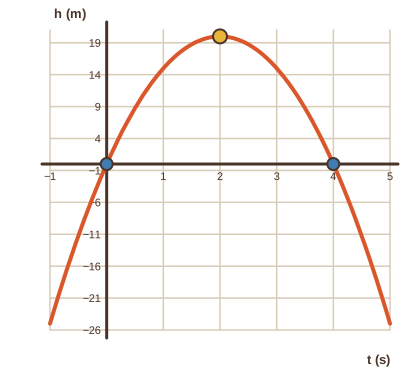
Nova lights each point and joins them in a smooth curve. "What do you notice?"
"It is a hill," Comet says. "Up, over the top, down. And 15 shows up twice."
"One second before the top and one second after," Wren says. "The curve is a mirror image. That is a parabola."
"And the top is the vertex," Comet says. "Two seconds, twenty meters. The highest the rocket gets."

A parabola and its parts
The graph of h(t) = -5t² + 20t is a parabola. Because a = -5 is negative, it opens down, like the rocket's arc.
The vertex is (2, 20): the top of the flight, at t = 2 seconds and 20 meters. It is the maximum.
The axis of symmetry is the line t = 2. Every height before the top shows up again the same time after it.
The t-intercepts are 0 and 4, the launch and the landing. The h-intercept is h(0) = 0.
Reading the graph for the build
| Feature | On the graph | For the rocket |
|---|---|---|
| t-intercepts | t = 0 and t = 4 | launch and landing |
| vertex | (2, 20) | highest point, 20 m at 2 s |
| axis of symmetry | t = 2 | the way up mirrors the way down |
| increasing | 0 < t < 2 | the rocket is climbing |
| decreasing | 2 < t < 4 | the rocket is falling |
| positive | 0 < t < 4 | the rocket is in the air |
The vertex of y = ax² + bx + c is at x = -b ÷ 2a. Here that is -20 ÷ (2 × -5) = 2, and h(2) = 20.
Read every feature twice: once as a point on the graph, once as a moment in the flight.
- Read the question.
- Tap your answer.
| Statement | True or false? |
|---|---|
| A parabola with a negative a opens down. | ? |
| h(1) and h(3) are equal because 1 and 3 are the same distance from t = 2. | ? |
| -5 × 1 × 1 + 20 × 1 = -5 × 3 × 3 + 20 × 3 | ? |
| The vertex of the rocket's graph is its lowest point. | ? |
| 0 - 20 ÷ (2 × (0 - 5)) = 2 | ? |
Hold it over your drawn parabola and check that both sides match.
Great start. Tomorrow you graph parabolas by hand two ways and compare them.