Wednesday
Wednesday: Data Lab, Forty Draws From the Lane Bag
"Lab day," Comet says, setting the bag on the picnic table. "Draw a token, write it down, put it back, shake."
"Forty draws," Wren says. "I sort each one two ways. Even or odd. Low or high, with lane 5 counted as high."
Comet draws. "Six." Wren marks even and high. "Three." Odd and low. The tally grows.
After forty, Wren reads the four boxes. "9 even and low. 11 even and high. 12 odd and low. 8 odd and high."
Nova projects the table with totals. "Would you like a hint? Compare P(even given low) with P(even)."
"Given low, 9 of 21," Comet says. "3/7. The bag says 1/2. Close, not equal."
"What do you notice?" Wren asks. "Forty draws wobble. The bag does not owe us an exact match."
What you need
- A cloth bag or a cup and 8 tokens or paper scraps numbered 1 to 8.
- Your Run Log and a pencil for a two-row, two-column tally grid.
- A partner to call out even or odd and low or high, and a grown-up aware of where you are.
Cut paper scraps with scissors on paper or cardboard, never toward a hand.
Any jogging this week happens on the park loop or a safe path, with a grown-up aware and water at hand. No one runs on a road.
Nothing heavy is lifted alone.
Run the lab
- Number 8 scraps 1 to 8 and put them in the bag. Shake it.
- Draw one token. Write its number in your Log, then put it back and shake again.
- Mark each draw in the grid: even or odd, and low (1 to 4) or high (5 to 8).
- Repeat until you have 40 draws. Write the row, column and grand totals.
- Find P(even), P(low), P(even and low) and P(even given low) from your own table.
- Compare each with the bag's true values: 1/2, 1/2, 1/4 and 1/2.
The crew's lab table
The crew's counts are made up for the Run Log. Yours will differ, and the comparison is the point.
| low (1 to 4) | high (5 to 8) | Total | |
|---|---|---|---|
| even | 9 | 11 | 20 |
| odd | 12 | 8 | 20 |
| Total | 21 | 19 | 40 |
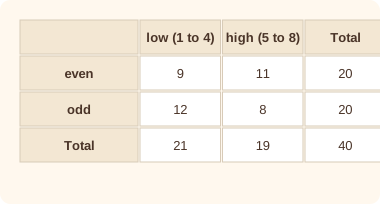
In the crew's run, P(even and low) = 9/40 and P(even) × P(low) = 21/80. In the bag itself, both are exactly 1/4.
A sample of forty draws lands near the true values, not on them. Tomorrow you learn the exact test for independence.
- Read the question.
- Tap your answer.
One of the 40 draws is picked at random from the Log. What is the probability it was even?One of the 40 draws is picked at random from the Log. What is the probability it was low?Given that a logged draw was low, what is the probability it was even?What is the probability a logged draw was even or low (or both)?| Statement | True or false? |
|---|---|
| 9 + 11 + 12 + 8 = 40 | ? |
| Putting the token back keeps every draw at the same eight equally likely outcomes. | ? |
| Forty draws will always match the bag's true probabilities exactly. | ? |
| P(even given low) uses the low column as its total. | ? |
Good lab work. Tomorrow you test independence exactly and see why a conditional probability uses the group total.