Monday
Monday: The Lane Draw as a Sample Space
Eight numbered tokens rattle in the cloth bag. "Eight lane spots for the first heat," Comet says. "Fair draw."
"Before you pull one," Wren says, "what are all the things that could happen?"
"A 1, a 2, up to an 8," Comet says. "Eight outcomes, each as likely as the next."
Wren rules a grid on his clipboard, one box per token. "Now circle the even lanes."
Comet circles 4 boxes. "And the low lanes, 1 to 4." She draws a second loop around 4 boxes.
"What do you notice?" Wren asks. "Two boxes sit inside both loops."
Nova hovers with the Run Log glowing. "Would you like a hint? The whole grid is your sample space."
"And every question about the draw is a set of boxes," Comet says. "Or, and, not. Let us name them."
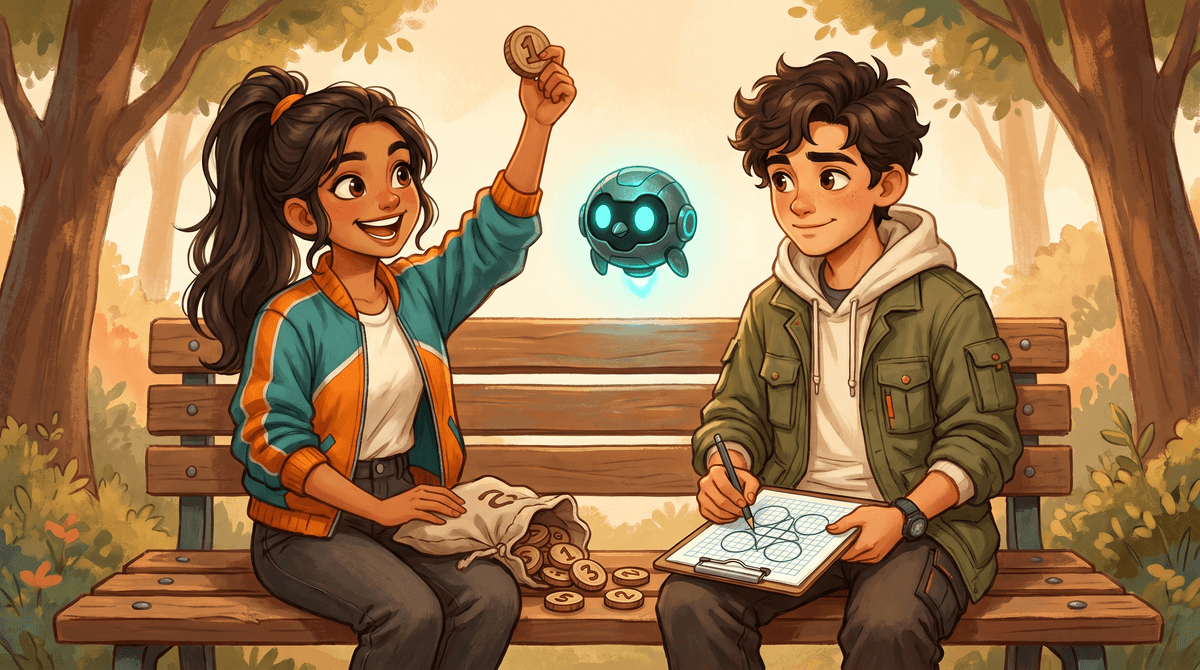
The crew's lane bag
Every number this week is the crew's own reading from Nova's Run Log. The bag holds 8 tokens numbered 1 to 8, one lane spot each.
The sample space is the set of all outcomes: {1, 2, 3, 4, 5, 6, 7, 8}. Each token is equally likely, so each has probability 1/8.
Events as sets of outcomes
An event is a set of outcomes. "Even lane" is {2, 4, 6, 8}. "Low lane" (1 to 4) is {1, 2, 3, 4}.
"Even and low" keeps only the outcomes in both sets: {2, 4}. That is the intersection.
"Even or low" gathers every outcome in either set, counting shared ones once: {1, 2, 3, 4, 6, 8}. That is the union.
"Not even" is every outcome outside the even set: {1, 3, 5, 7}. That is the complement.
| Event | Outcomes | Count | Probability |
|---|---|---|---|
| even | {2, 4, 6, 8} | 4 | 1/2 |
| low (1 to 4) | {1, 2, 3, 4} | 4 | 1/2 |
| even and low | {2, 4} | 2 | 1/4 |
| even or low | {1, 2, 3, 4, 6, 8} | 6 | 3/4 |
| not even | {1, 3, 5, 7} | 4 | 1/2 |
A solved problem to study
Here is how Wren finds the probability that the drawn lane is even or low.
- List the even outcomes: {2, 4, 6, 8}, 4 of them.
- List the low outcomes: {1, 2, 3, 4}, 4 of them.
- Join the two lists, writing each outcome once: {1, 2, 3, 4, 6, 8}. The shared outcomes 2 and 4 appear once, not twice.
- Count the union: 6 outcomes.
- Divide by the size of the sample space: 6 ÷ 8 = 3/4.
A probability is a count over a count: the outcomes in the event over all the outcomes. Write it in lowest terms.
- Read the question.
- Tap your answer.
- Read the question.
- Tap your answer.
| Statement | True or false? |
|---|---|
| Every token belongs to exactly one outcome of the sample space. | ? |
| 4 + 4 - 2 = 6 | ? |
| P(not even) = 1 - P(even). | ? |
| The union of two events always has as many outcomes as the two counts added. | ? |
The face-up cards on the left are the intersection. Every card that is face up or on the left is the union.
A clear start. Tomorrow the addition rule turns the "or" count into a formula, and you check it two ways.