Monday
Monday: A Model and a Run of Tails
The pacing trial starts at the park loop. Before each practice lap, a coin decides who leads.
"Heads, Comet leads. Tails, I lead," Wren says, flipping over the tally sheet.
Tails. Tails. Tails. Tails. Tails. Comet stares at the row. "5 tails in a row. Is this coin fair?"
"The model says heads half the time," Wren says. "What do you notice? We have not tested it yet."
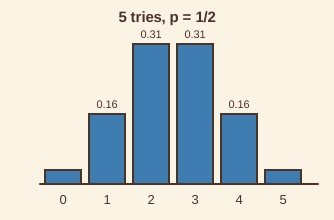
Nova hovers up a bar graph of possible head counts. "Would you like a hint? Count the orders for 5 flips."
"32 orders, all equally likely," Comet says. "Only one is all tails. That is 1/32."
"Rare, but not impossible," Wren says. "A fair coin does this about once in thirty-two tries."
"Then we keep flipping and keep counting," Comet says. "The whole run will tell us more than five flips."

The model and the question
A probability model is a claim about chance. The crew's model: a fair coin lands heads with probability 1/2, and every flip is independent.
This week asks one question of every result: could this model easily produce it? If yes, the result is consistent with the model.
If the result would almost never happen under the model, the crew questions the model, not the result.
Every flip in this course is the crew's own reading from Nova's Run Log, written for this lesson.
A solved problem to study
Here is how Wren finds the probability of exactly 2 heads in 5 fair flips.
- Each flip has 2 outcomes, so 5 flips have 2 × 2 × 2 × 2 × 2 = 32 orders. The fair coin makes them equally likely.
- Count the orders with exactly 2 heads: choose which 2 of the 5 flips are heads. C(5, 2) = 10.
- Divide: 10 ÷ 32 = 5/16.
- Check with the formula: C(5, 2) × (1/2)^2 × (1/2)^3 = 10 × 1/32 = 5/16.
- All 5 tails is one order of 32: 1/32. So is all 5 heads.
The formula says: count the orders with k successes. Then multiply by p for each success and 1 - p for each failure.
| Heads in 5 flips | Orders | Probability |
|---|---|---|
| 0 | 1 | 1/32 |
| 1 | 5 | 5/32 |
| 2 | 10 | 10/32 |
| 3 | 10 | 10/32 |
| 4 | 5 | 5/32 |
| 5 | 1 | 1/32 |
- Read the question.
- Tap your answer.
Comet flips a fair coin 5 times. What is the probability of exactly 2 heads?Wren flips a fair coin 5 times. What is the probability of exactly 1 head?| Statement | True or false? |
|---|---|
| 10 ÷ 32 = 5/16 | ? |
| Five tails in a row has probability 1/32 under the fair-coin model. | ? |
| A rare result proves the model is wrong. | ? |
| Each flip of a fair coin is independent of the flips before it. | ? |
Count them and write the probability as a fraction. Compare with C(3, 2) ÷ 8.
A strong start. Tomorrow you build the whole distribution two ways and find the count the model expects.