Friday
Friday: Careful Words
"The poster," Comet says, holding a marker. "Practice and laps, r close to 1. What do we write?"
"Not 'practice makes you run more laps'," Wren says. "Write what we saw. Runners with more weeks of practice ran more laps."
"That is longer," Comet says. "But honest. And the warm-up line?"
"Runners who warmed up longer ran faster laps in our log," Wren says. "r = -0.98. Strong, together, not proven cause."
Nova projects three everyday claims, each with a lurking variable glowing beside it. "Would you like a hint? Ask who else could be behind the pattern."
"Together, not because of," Comet writes along the bottom of the poster. "Our motto for the week."
"And one more line," Wren says. "Only a fair-draw experiment can test a cause. Week nine."
Everyday claims, careful readings
Everyday talk turns "together" into "because of" all the time. The careful reader asks three questions.
How tight is the pattern? Read r for the strength. Could a third factor drive both? Name a lurking variable.
Could the direction be backwards? Then ask: what experiment, with a fair draw, could test the cause?
| Everyday claim | What the data shows | Careful words |
|---|---|---|
| Practice makes runners run more laps. | r = 0.98, strong positive | Runners with more practice ran more laps. Together, not proven cause. |
| Warming up makes laps faster. | r = -0.98, strong negative | Longer warm-ups went with faster laps. A fair-draw experiment could test it. |
| New shoes make runners faster. | r = -0.98, strong negative | Practice weeks lurk behind shoe sessions. Not proven cause. |
| Warm-up minutes decide laps run. | r = 0.54, weak positive | A loose cloud. Little to say at all. |
Review: r in one list
- r runs from -1 to 1. Sign gives direction. Size gives strength: 0.7 strong, under 0.3 little or none.
- r measures straight-line tightness only. Look at the plot for curves.
- r is the average of the products of the x and y z-scores. Technology computes it.
- Chance alone makes small values of r. A large r is hard to get from a bag.
- Correlation is not causation. Name the lurking variable. Only a randomized experiment shows a cause.
- Read the question.
- Tap your answer.
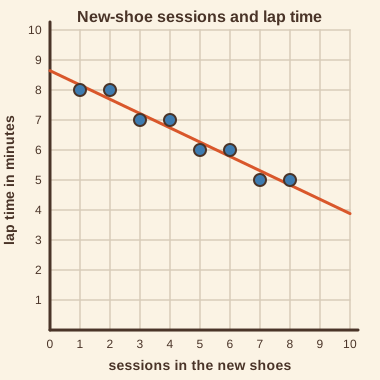 Shoe sessions against lap time: (1, 8), (2, 8), (3, 7), (4, 7), (5, 6), (6, 6), (7, 5), (8, 5). What is r? (Round to 2 places.)
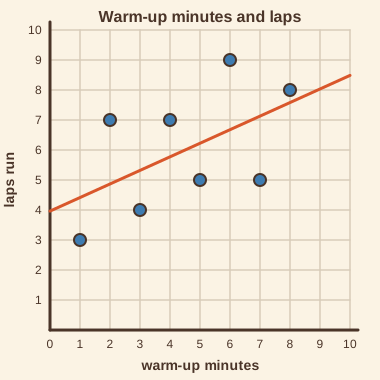 Warm-up minutes against laps gave r = 0.54. How would you describe the linear relationship?
- Read the question.
- Tap your answer.
| Statement | True or false? |
|---|---|
| "Together, not because of" is a fair summary of what r shows. | ? |
| An r of -0.98 is weaker than an r of 0.54. | ? |
| Only a randomized experiment can show a cause. | ? |
| A careful sentence about r never uses the word "makes". | ? |
Rewrite it in careful words, name a lurking variable, and sketch the experiment that could test it.
Careful words, well chosen. Tomorrow is Track Day: a family scatter plot, an r by eye, and a careful sentence.