Monday
Monday: One Lap Far From the Rest
The crew's table sits under the big tree by the loop. Wren spreads out Wednesday's lap sheet.
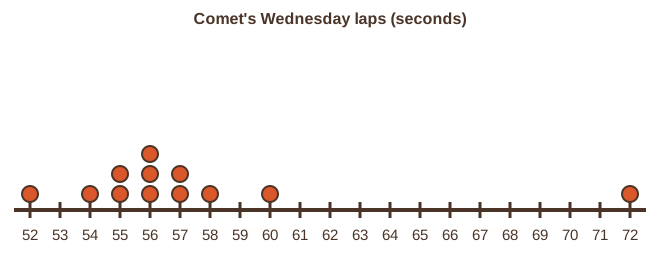
"Twelve laps," he says. "52, 54, 55, 55, 56, 56, 56, 57, 57, 58, 60, 72. What do you notice?"
"That 72," Comet says. "I stopped to tie my shoe. It sits way off by itself."
Wren circles the far dot. "One value like that can pull the mean. Does it pull the median too?"
Nova shows both centers. "Mean 57.3. Median 56. Would you like a hint? Try the set without that lap."
"Without it, the mean drops to 56," Comet says. "The median stays at 56. It did not budge."
"We need a rule for which values count as far off," Wren says. "Not a feeling. A rule with a number."
"What can we make?" Comet asks. "A fence. Anything outside the fence is an outlier."

Comet's Wednesday laps
Every number this week is the crew's own made-up reading from Nova's Run Log. Twelve laps, and one of them includes a shoe stop.
| Lap | 1 | 2 | 3 | 4 | 5 | 6 | 7 | 8 | 9 | 10 | 11 | 12 |
|---|---|---|---|---|---|---|---|---|---|---|---|---|
| Seconds | 52 | 54 | 55 | 55 | 56 | 56 | 56 | 57 | 57 | 58 | 60 | 72 |
A solved problem to study: the 1.5 × IQR rule
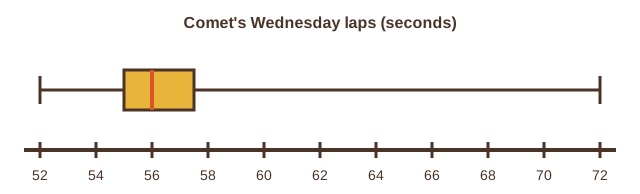
Here is how Wren decides whether the far lap is an outlier. The rule uses the quartiles, so it does not depend on the far value itself.
- Find the quartiles: Q1 = 55 and Q3 = 57.5. The IQR is 57.5 - 55 = 2.5.
- Multiply the IQR by 1.5: 1.5 × 2.5 = 3.75.
- Upper fence: Q3 + 1.5 × IQR = 57.5 + 3.75 = 61.25.
- Lower fence: Q1 - 1.5 × IQR = 55 - 3.75 = 51.25.
- Any value outside the fences is an outlier. 72 is above 61.25, so it is one. 60 is inside, so it is not.
What the outlier does
| Measure | With the far lap | Without it |
|---|---|---|
| Mean | 57.3 | 56 |
| Median | 56 | 56 |
| Standard deviation | 4.8 | 2 |
| IQR | 2.5 | 2 |
The mean moves by 1.3 seconds and the standard deviation more than doubles. The median does not move at all.
Measures that barely move are called resistant. The median and IQR are resistant. The mean and standard deviation are not.
- Read the question.
- Tap your answer.
| Statement | True or false? |
|---|---|
| 57.5 + 1.5 × 2.5 = 61.25 | ? |
| An outlier pulls the mean toward itself. | ? |
| The median moves as far as the mean when one value becomes extreme. | ? |
| A lap of 60 seconds is an outlier in Comet's set. | ? |
A fence with a number. Tomorrow the stretch cards come out, and a very different shape appears: a bell.