Thursday
Thursday: Samples and Fair Games
Rocket spreads the Field Day sign-up list across the Numbers Desk. "Forty-eight kids on our street. I cannot ask them all which game they want first."
"Then ask some of them," Raven says. "But which some?"
"The six kids next door," Rocket says. "They are right there."
Nova hovers. "Do the six kids next door look like the whole street?"
Rocket thinks. "No. They are all little. They would all pick the sack hop."
"So pick fairly," Raven says. She writes every kid's number on a slip and drops the slips in a hat. "Draw sixteen."
Rocket draws. "Sixteen out of forty-eight, picked by chance. Nobody chosen on purpose."
"That is a random sample," Nova says. "Now it can speak for the street."
Population and sample
A population is the whole group you want to know about. Here it is all 48 kids on the crew's street, by the crew's own count.
A sample is the smaller group you actually ask. The crew asked 16 kids.
A sample can only speak for the population if it is representative. That means it looks like the whole group, not just one corner of it.
Picking at random, so every kid has the same chance of being chosen, is the fair way to get a representative sample.
Asking only the six kids next door would be a biased sample. It would over-count whatever those six happen to like.
From sample to population
Of the 16 kids in the sample, 6 picked the relay as their first game. That is 6/16 = 3/8 of the sample.
If the sample is representative, about 3/8 of the whole street would pick the relay too: 3/8 × 48 = 18 kids.
That is an estimate, not an exact count. A different random sample of 16 would give a slightly different number.
| First game picked | Kids in the sample | Fraction of the sample | Estimate for all 48 |
|---|---|---|---|
| relay | 6 | 3/8 | 18 |
| sack hop | 4 | 1/4 | 12 |
| hoop toss | 4 | 1/4 | 12 |
| paper ball toss | 2 | 1/8 | 6 |
- Read the question.
- Tap your answer.
Fair spinner games
A Field Day spinner game is fair when every player has the same probability of winning.
Three players, three equal sectors: each player wins with probability 1/3. That game is fair.
Now give one player 3 sectors of 4 and the other 1. Red wins with probability 3/4 and blue with 1/4. Not fair.
To test a game, predict each player's wins, play many rounds, and compare. If one player wins far more than predicted, check the spinner.
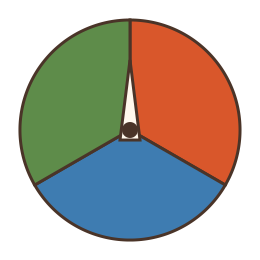
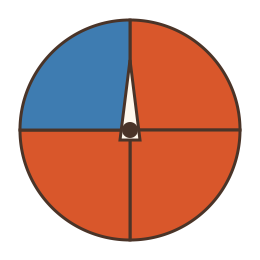
- Read the question.
- Tap your answer.
What is the probability of green winning on the three-color spinner?What is the probability of red winning on the three-red, one-blue spinner?| Statement | True or false? |
|---|---|
| A population is the whole group you want to know about. | ? |
| Asking only the six kids next door gives a representative sample of the street. | ? |
| 6 of 16 is 3/8 of the sample. | ? |
| A spinner with equal sectors is always a fair game for two players. | ? |
| An estimate from a sample is exact for the whole population. | ? |
Then design an unfair one and say who it favors and by how much.
Random samples and fair games: two ways chance keeps things honest. Tomorrow you plan your Data Fair.