Monday
Monday: Repeated Hops
Rocket drops a crumpled paper ball into the bowl on the Numbers Desk. "New Field Day game. Every miss is -2 points."
"I missed three times in practice," he says. "So that is -2, -2, -2. Which is... -2 three times."
Raven writes 3 × (-2) on the whiteboard. "What do you notice about the hops?"
"Three hops, each one 2 to the left," Rocket says. "I land on -6."
Nova hovers over the taped number line, her light blinking once at each landing spot. "Multiplying is hopping the same hop again and again," she says.
"So four misses is 4 × (-2) = -8," Rocket says. "I should miss less."
Raven grins. "Or we find out what (-2) × 3 means. This week, the hops repeat."

Multiplying is repeated hopping
You already know 3 × 2 means three groups of 2, or three hops of 2 to the right: 6.
So 3 × (-2) means three hops of -2. Each hop goes 2 to the left. Start at 0 and land on -6.
A positive number times a negative number is negative. The size is the same as 3 × 2, only the direction changes.
What about (-2) × 3? Multiplication can be done in either order, so (-2) × 3 = 3 × (-2) = -6.
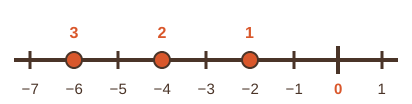
Think of a miss worth -2 points. Three misses give 3 × (-2) = -6 points. Five misses give 5 × (-2) = -10.
A thermometer that drops 3 degrees every hour for 4 hours changes by 4 × (-3) = -12 degrees.
Every repeated loss is a multiplication with a negative number.
Dividing undoes multiplying
If 3 × (-2) = -6, then -6 ÷ 3 = -2. Dividing asks: what hop, repeated 3 times, lands on -6?
And -6 ÷ (-2) = 3 asks: how many hops of -2 reach -6? Three hops.
Rocket lost 10 points in 5 misses. Each miss was worth -10 ÷ 5 = -2 points.
- Multiply the sizes as if both numbers were positive.
- Count the negative numbers. One negative number means the answer is negative.
- Picture the hops to check: a negative hop repeated lands left of 0.
- Read the question.
- Tap your answer.
- Read the question.
- Tap your answer.
- Read the question.
- Tap your answer.
| Number sentence | True or false? |
|---|---|
| 3 × (-2) = -6 | ? |
| (-2) × 3 = 6 | ? |
| -6 ÷ 3 = -2 | ? |
| -6 ÷ (-2) = -3 | ? |
Now lay out -12 as twelve negative counters and share them into 4 equal groups. That is -12 ÷ 4.
Good hopping. Tomorrow you meet the puzzle of the week: what is a negative times a negative?