Tuesday
Tuesday: Equivalent Ratios
Raven tapes a sheet of paper to the Numbers Desk and draws two columns: Blue and Yellow.
Rocket fills it in fast. "2 and 3. Then 3 and 4. Then 4 and 5. I just add one each time."
He mixes the 4 and 5 batch. It comes out a dull blue-green, nothing like the sign color.
"What do you notice?" Raven asks. Rocket frowns. "It is wrong, but the numbers went up together."
Nova dips lower, her light pulsing slowly. "Yesterday you made a batch twice as big. What did you do to both numbers?"
"Multiplied," Rocket says. "Both of them. By the same number."
Raven hands him the marker. "Then fix the table."
Multiply both parts by the same number
Equivalent ratios show the same relationship. To make one, multiply both parts by the same number.
2:3 becomes 4:6 when both parts are multiplied by 2. It becomes 6:9 when both are multiplied by 3.
Adding the same number to both parts does not work. 3:4 is not the same green as 2:3.
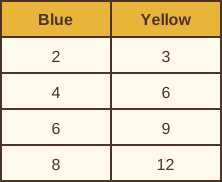
- Write the ratio you know: 2 blue to 3 yellow.
- Pick a number to multiply by, like 4.
- Multiply both parts: 2 × 4 = 8 and 3 × 4 = 12.
- Write the new row in the table: 8 blue, 12 yellow.
Find a missing value
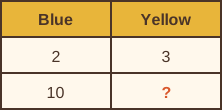
A ratio table may have a blank. Find what the known part was multiplied by, then multiply the other part the same way.
In the table below, blue went from 2 to 10. That is multiplying by 5, so yellow is 3 × 5.
- Read the question.
- Tap your answer.
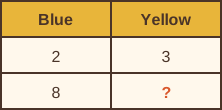 Blue 2 and yellow 3 in the first row. Blue 8 in the next row. What is yellow?
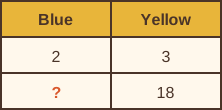 Blue 2 and yellow 3 in the first row. Yellow 18 in the next row. What is blue?
- Read the question.
- Tap your answer.
- ?3 cup lemon juice and 12 cups water
- ?4 cup lemon juice and 16 cups water
- ?1 cup lemon juice and 4 cups water
- ?2 cup lemon juice and 8 cups water
| Statement | True or false? |
|---|---|
| 2:3 is the same ratio as 4:6. | ? |
| 2:3 is the same ratio as 3:4. | ? |
| 1:4 is the same ratio as 3:12. | ? |
| 5:2 is the same ratio as 10:6. | ? |
Make a second strip with 10 pieces, 4 blue and 6 yellow. Hold them side by side.
What stays the same about the two strips? What changes?
Well fixed. Tomorrow the Numbers Lab opens and you mix real batches to test the table.