Monday
Monday: What a Ratio Is
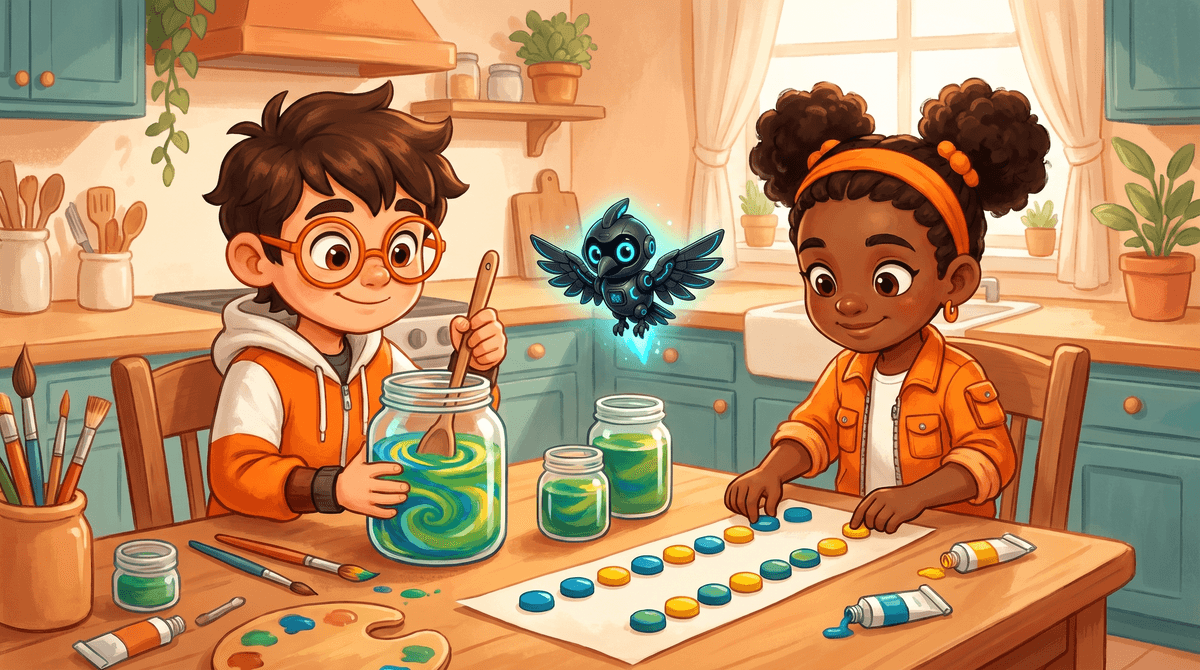
Rocket drops a stack of paper onto the kitchen table. "Field Day needs signs. Green signs. Lots of them."
Raven sets out two jars of water-based paint, one blue and one yellow. "We mix the green ourselves."
Rocket grabs a spoon and adds blue, then yellow, then more blue. The puddle turns a muddy teal.
"What do you notice?" Raven asks. "Too much blue," Rocket admits.
Nova hovers over the tray, her light steady. "A good mix is a recipe. How many spoons of each color made the green you liked?"
Raven checks her notebook. "Two spoons blue, three spoons yellow. Every time."
Rocket grins. "Then this table is the Numbers Desk now. We are going to need a lot of green."
Two quantities, one comparison
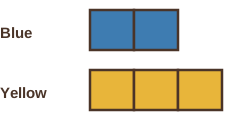
A ratio compares two quantities. Raven's green uses 2 spoons of blue for every 3 spoons of yellow.
We write that ratio as 2:3, or 2 to 3. The order matters: blue first, then yellow.
The ratio of yellow to blue is 3:2. Same paint, opposite order.
A ratio can also compare a part to the whole. Each batch has 5 spoons in all, so blue to all the paint is 2:5.
Worked example: a bigger batch
Rocket wants a batch twice as big. He doubles both parts: 4 spoons of blue and 6 spoons of yellow.
The ratio 4:6 is equivalent to 2:3. Both parts were multiplied by 2, so the green stays exactly the same.
If he doubled only the blue, the ratio would change. So would the color.
- Read the question.
- Tap your answer.
- Read the question.
- Tap your answer.
- Read the question.
- Tap your answer.
Make a second group that shows 4:6. Line the groups up and compare them.
Say each ratio aloud three ways: 2 to 3, 2:3, and 2 for every 3.
Nothing from the Numbers Desk goes in anyone's mouth.
Strong start. Tomorrow Raven builds a ratio table so the crew can mix any size batch.