Tuesday
Tuesday: From the Foci to the Equation
"Yesterday we trusted a and b," Wren says, pinning graph paper to the Boathouse wall. "Today we earn the equation."
"Start from the definition," Comet says. "Distance to one focus plus distance to the other equals 2a."
She writes two square roots with the distance formula and a plus sign between them. "Ugly."
Nova glows a square around the whole line. "Would you like a hint? Square it, but move one root across first."
"Then one root is left," Wren says. "Isolate it, square again, and the roots are gone."
"And the shortcut," Comet says. "Read a from the vertex, b from the top, and skip the algebra."
"Both ways should land on the same equation," Wren says. "Let us check."
Way one: the algebra from the definition
- Foci at (-c, 0) and (c, 0). Let P = (x, y) be a point whose distances to them add to 2a.
- Distance formula: √((x + c)² + y²) + √((x - c)² + y²) = 2a.
- Move the second root to the right side. Square both sides. One root remains, with a factor of 4a.
- Isolate that root. Square both sides again. Now every root is gone.
- Collect terms: (a² - c²)x² + a²y² = a²(a² - c²).
- Let b² = a² - c² and divide every term by a²b². The result is x²/a² + y²/b² = 1.
The two squarings are the whole trick. Each one removes a root, and the second leaves only squares of x and y.
The name b² = a² - c² is not a guess. It is the quantity that appears on its own after the algebra.
Way two: read the picture
The vertex (a, 0) is on the curve, so a² /a² = 1 fixes the x² term. The top (0, b) fixes the y² term.
Pythagoras at the top gives b² = a² - c². For the lawn oval, a = 5, c = 4, b = 3: x²/25 + y²/9 = 1.
The picture way is faster. The algebra way proves the picture way is allowed. The crew keeps both in the log.
| a (half the string) | c (half the stake gap) | b² = a² - c² | Equation |
|---|---|---|---|
| 5 | 4 | 25 - 16 = 9 | x²/25 + y²/9 = 1 |
| 5 | 3 | 25 - 9 = 16 | x²/25 + y²/16 = 1 |
| 6 | 2 | 36 - 4 = 32 | x²/36 + y²/32 = 1 |
| 10 | 6 | 100 - 36 = 64 | x²/100 + y²/64 = 1 |
Read down the table. The same string with stakes closer together gives a bigger b and a rounder oval.
If the stakes meet at the center, c = 0, b = a, and the oval is a circle of radius a. A circle is an ellipse with its foci together.
- Read the question.
- Tap your answer.
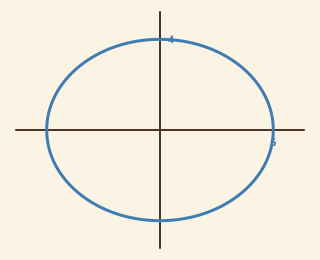 An oval has a = 5 and c = 3, so b = 4. Centered at the origin with the long axis across, what is its equation?
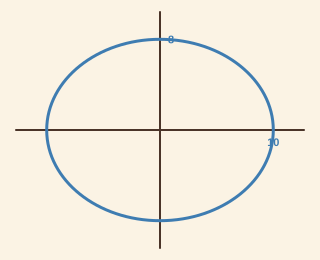 A string of 20 m is tied to stakes 12 m apart, so a = 10 and c = 6. What is the oval's equation?
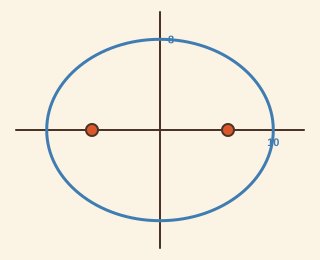 Where are the foci of the ellipse x²/100 + y²/64 = 1?
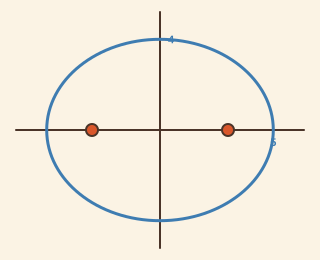 Where are the foci of the ellipse x²/25 + y²/16 = 1?
| Statement | True or false? |
|---|---|
| Squaring twice removes both square roots in the derivation. | ? |
| b² = a² - c² appears on its own in the algebra; it is not a guess. | ? |
| An ellipse with its two foci at the same point is a circle. | ? |
| Moving the stakes apart with the same string makes the oval rounder. | ? |
| 25 - 9 = 16 | ? |
Pick one more point on your sketch, such as (3, 2.4). Measure its two focus distances with a ruler and add them.
Excellent. Tomorrow the pins and string come out in the Boathouse Lab, and you measure the constant sum yourself.