Monday
Monday: String, Two Stakes and Chalk
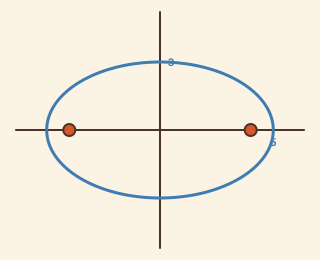
Comet drives two stakes into the lawn, 8 meters apart. She ties each end of a 10 meter string to a stake.
She hooks the chalk inside the string, pulls it tight and walks. A smooth oval appears on the grass.
"Not a circle," Wren says. "What do you notice? The chalk is never the same distance from either stake."
"But the string never changes," Comet says. "Chalk to one stake plus chalk to the other is always ten."
Nova projects two glowing lines from the chalk to the stakes. "Would you like a hint? Stand at the far end of the oval."
"There it is 1 to the near stake and 9 to the far one," Wren says. "Sum 10. And at the top?"
"Five and five," Comet says. "Same sum. That is the rule for every point. Let us write it as an equation."

The definition of an ellipse
An ellipse is the set of points whose distances to two fixed points add to a constant. The fixed points are the foci.
The string shows why: its length never changes, and it runs from one stake to the chalk to the other stake.
Put the center at the origin and the foci at (-c, 0) and (c, 0). Here c = 4, since the stakes are 8 m apart.
Call the constant sum 2a. The vertices, the two ends of the oval, are at (±a, 0).
Why the string is 2a
Stand the chalk at the right vertex (a, 0). Its distance to the right focus is a - c and to the left focus is a + c.
Add them: (a - c) + (a + c) = 2a. So the string length is 2a, and the long axis is the whole string laid flat.
Now stand at the top, (0, b). Both distances are equal, so each is a. With the focus distance c, Pythagoras gives b² + c² = a².
So b² = a² - c². For the lawn oval, b² = 25 - 16 = 9, and b = 3. The oval is 6 m tall.
A solved problem to study
- Known: the stakes are 8 m apart and the string is 10 m. Find the equation of the chalk oval.
- Center it at the origin with the stakes on the x-axis. Half the stake gap: c = 4. Half the string: a = 5.
- b² = a² - c² = 25 - 16 = 9, so b = 3.
- The equation is x²/a² + y²/b² = 1, which here is x²/25 + y²/9 = 1.
- Check with the top point (0, 3): 0 + 9/9 = 1. True. Check (5, 0): 25/25 + 0 = 1. True.
- Answer: the oval is 10 m across and 6 m tall, with the stakes at (±4, 0).
Every length here is the crew's own string and tape reading from Nova's log, not a fact about any real lawn.
- Read the question.
- Tap your answer.
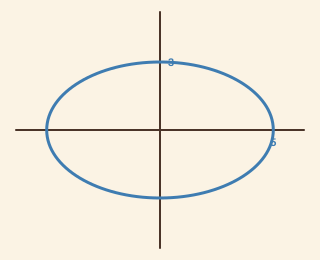 The chalk oval is 10 m across and 6 m tall, centered at the origin. What is its equation?The oval x²/25 + y²/9 = 1 is centered on the lawn's origin. Where are the two stakes, the foci?
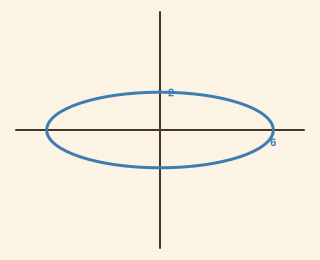 An ellipse centered at the origin has a horizontal half-axis 6 and a vertical half-axis 2. What is its equation?
| Statement | True or false? |
|---|---|
| Every point of the chalk oval has the same sum of distances to the two stakes. | ? |
| The string length equals the long axis, 2a. | ? |
| 25 - 16 = 9 | ? |
| For an ellipse, c² = a² + b². | ? |
| The stakes sit at the vertices of the oval. | ? |
Pull a pencil around inside the string. Measure the width and height of your oval and compare with 10 and 6.
Strong start. Tomorrow the definition becomes the equation, step by step, two ways.