Wednesday
Wednesday: Boathouse Lab, Sight It From Two Points
Comet stretches string across the lawn and marks 10 meters with chalk. "Baseline. The chair by the shed is our buoy."
Wren kneels at one end with the protractor flat on the string. "Fifty-eight degrees to the chair."
At the other end: "71 degrees." He writes both in the log.
"So the chair's angle is 51°," Comet says. "Law of Sines for the two distances. Then we check with the tape."
Nova hovers over the chair. "Would you like a hint? The distance straight to the baseline is a height, not a side."
"Right," Wren says. "Side times the sine of the angle at that end. About 10.3 meters."
Comet walks the tape straight from the chair to the string. "Close. Lab data is never perfect, and that is fine."
What you need
- A long string or tape measure, chalk or two stakes, a protractor, a notebook and a pencil.
- A target you can see from both ends of the string: a chair, a tree, a post. Not on the water.
- A grown-up to hold the far end of the tape and to check the lawn is clear of holes.
Work on a flat lawn or a driveway. Never stretch string across a path where someone could trip.
A grown-up handles any ladder, and nothing heavy is lifted alone. Scissors only for cutting string.
Run the lab
- Lay out a baseline of 10 meters, or as long as your space allows. Mark both ends A and B.
- From A, lay the protractor on the baseline and sight the target. Record angle A.
- From B, do the same. Record angle B. Compute C = 180° - A - B.
- Use the Law of Sines to find the distance from A to the target and from B to the target.
- Multiply the distance from A by sin A. That is the target's distance straight back to the baseline.
- Now walk the tape straight from the target to the baseline and measure. Record the difference.
The crew's lab log
Here are the crew's own readings from the lawn. All made-up Boathouse data, angles to the nearest degree.
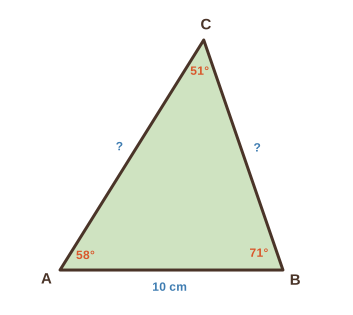
| Measurement | Reading | How it was found |
|---|---|---|
| baseline AB | 10 m | tape |
| angle at A | 58° | protractor |
| angle at B | 71° | protractor |
| angle at the chair | 51° | 180° minus the other two |
| A to chair | 12.2 m | 10 × sin 71° / sin 51° |
| B to chair | 10.9 m | 10 × sin 58° / sin 51° |
| chair to baseline | 10.3 m | 12.2 × sin 58° |
| chair to baseline, taped | 10.5 m | tape, walked straight |
The computed distance and the taped one differ by 0.2 meters. A protractor read to the nearest degree can do that.
The crew keeps both in the log. The method is sound; the readings carry the uncertainty.
- Read the question.
- Tap your answer.
With a 10 m baseline, A = 58° and B = 71°, how far is the chair from A, to 1 place?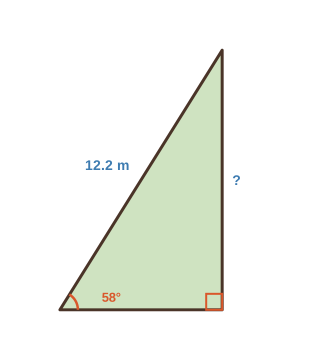 A right triangle has a 58° angle at A and a longest side of 12.2 m to the chair. How long is the side straight back to the baseline, to 1 place?
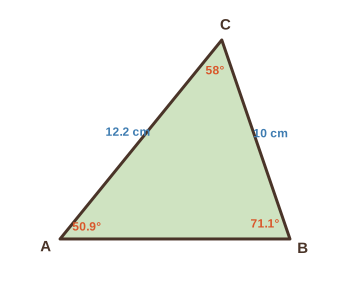 The lab triangle has sides 10 m and 12.2 m with a 58° angle between them. What is its area, to 1 place?
| What the lab shows | True or false? |
|---|---|
| The crew found the chair's distance without walking to it. | ? |
| The distance from the chair to the baseline is one of the triangle's sides. | ? |
| A one-degree protractor error can move the computed distance by a few tenths of a meter. | ? |
| The taped and computed distances must match exactly or the law is wrong. | ? |
Fine lab work. Tomorrow is derivation day: you see why both laws are true, one dropped height at a time.