Thursday
Thursday: Why the Laws Are True
"Yesterday we used the laws," Wren says, chalking a big triangle on the dock. "Today we say why they hold."
He drops a dashed line from C straight down to side c. "One height, h. It cuts the triangle into two right ones."
"In the left one, sin A = h over b," Comet says. "In the right one, sin B = h over a."
Nova glows the two equations side by side. "Would you like a hint? Both equal h. Set them equal."
"b sin A = a sin B," Wren writes. "Divide by sin A and sin B. There is the Law of Sines."
"And area is half of c times h," Comet adds. "Replace h with b sin A. Half of c b sin A."
"Pythagoras on the same two right triangles gets us the Law of Cosines," Wren says. "Three proofs, one height."
Derivation one: area = ½ab sin C
- Draw triangle ABC. Drop a height h from B straight down to side b (the side AC).
- Area of any triangle is ½ × base × height, so area = ½ × b × h.
- The height h is the side opposite angle C in a right triangle whose longest side is a.
- So sin C = h/a, which means h = a sin C.
- Replace h: area = ½ × b × a sin C = ½ab sin C.
Check with the ropes: ½ × 8 × 11 × sin 52°. That is ½ × 8 × 11 × 0.788 ≈ 34.7 square meters.
Derivation two: the Law of Sines, read first
- Drop a height h from C to side c. It makes two right triangles that share h.
- In the right triangle at A: sin A = h/b, so h = b sin A.
- In the right triangle at B: sin B = h/a, so h = a sin B.
- Both equal h, so b sin A = a sin B.
- Divide both sides by sin A sin B: a/sin A = b/sin B.
- Drop a height from A instead and repeat: b/sin B = c/sin C. All three ratios are equal.
- ?In the triangle at A: h = b sin A
- ?Drop a height h from C to side c, making two right triangles
- ?In the triangle at B: h = a sin B
- ?Drop a height from A to bring in c/sin C
- ?Divide by sin A sin B: a/sin A = b/sin B
- ?Both equal h, so b sin A = a sin B
Derivation three: the Law of Cosines
- Drop a height h from B to side b. It lands at a point D, splitting b into two pieces.
- In the right triangle at C: the piece CD = a cos C, and h = a sin C.
- The other piece AD = b - a cos C.
- Pythagoras in the right triangle at A: c² = h² + AD² = (a sin C)² + (b - a cos C)².
- Expand: c² = a² sin²C + b² - 2ab cos C + a² cos²C.
- Since sin²C + cos²C = 1: c² = a² + b² - 2ab cos C.
The Pythagorean identity from Algebra 2 does the last step. The Law of Cosines is Pythagoras plus a correction for the lean.
A mixed set
- Read the question.
- Tap your answer.
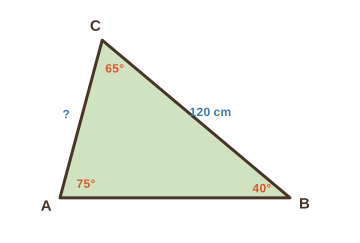 In the buoy triangle the baseline of 120 m faces the 75° angle at the buoy. Find the side facing the 40° angle, to 1 place.
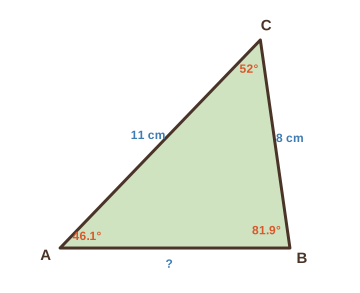 Ropes of 8 m and 11 m leave the dock corner 52° apart. How far apart are their far ends, to 1 place?
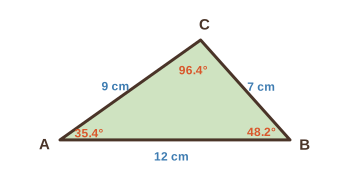 Stakes 7, 9 and 12 meters apart. Find the angle across from the 12 m side, to 1 place.
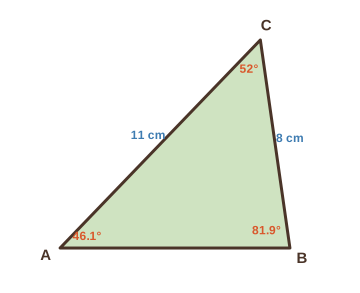 Two ropes of 8 m and 11 m meet at 52°. What area do they fence with the segment joining their ends, to 1 place?
Which solution makes sense?
For the three stakes, arccos gave 96.4°, an obtuse angle. The Law of Sines could not tell you that: sin 96.4° and sin 83.6° are equal.
So when a triangle might have an obtuse angle, find that angle with the Law of Cosines first. Arccos never hides an obtuse answer.
And if the SSS cosine comes out beyond -1 or 1, the three lengths do not make a triangle at all.
| Statement | True or false? |
|---|---|
| Area = ½ab sin C uses the angle between sides a and b. | ? |
| The Law of Sines proof uses one height written two ways. | ? |
| The Law of Cosines proof uses sin²C + cos²C = 1. | ? |
| The Law of Sines can tell an obtuse angle from its supplement. | ? |
| 0.5 × 8 × 11 = 44 | ? |
Clear reasoning. Tomorrow the laws show up around the Boathouse, and the week comes back in a mixed set.