Thursday
Thursday: The Binomial Theorem and a Proof
"Expand (x + 2)³," Wren says. "No multiplying three brackets. Use row 3: 1, 3, 3, 1."
Comet writes it out. "x³, then 3 times x² times 2, then 3 times x times 2², then 2³. So x³ + 6x² + 12x + 8."
"What do you notice about the powers?" Wren asks. "The x power drops by one each term. The 2 power climbs."
"They always add to 3," Comet says. "What if the second term is negative, like (x - 1)⁴?"
Nova projects alternating signs. "Would you like a hint? Odd powers of -1 are negative."
"x⁴ - 4x³ + 6x² - 4x + 1," Comet writes. "Plus, minus, plus, minus, plus."
"Now the other promise," Wren says. "Prove every quadratic has two zeros. Complete the square and watch."
The Binomial Theorem
(x + y)ⁿ = C(n, 0)xⁿ + C(n, 1)xⁿ⁻¹y + C(n, 2)xⁿ⁻²y² + ... + C(n, n)yⁿ, where C(n, k) is row n, entry k of Pascal's triangle.
In every term the powers of x and y add to n. The coefficients read straight across row n.
If the second term is a number or has a sign, raise it to the power too. (x - 1)⁴ puts (-1)ᵏ in term k, so the signs alternate.
For (2x - 1)³, raise 2x to the power as well: 8x³ - 12x² + 6x - 1.
Expansions from the plank rows
| Binomial | Row used | Expansion |
|---|---|---|
| (x + 2)³ | 1, 3, 3, 1 | x³ + 6x² + 12x + 8 |
| (x - 1)⁴ | 1, 4, 6, 4, 1 | x⁴ - 4x³ + 6x² - 4x + 1 |
| (x + 1)⁵ | 1, 5, 10, 10, 5, 1 | x⁵ + 5x⁴ + 10x³ + 10x² + 5x + 1 |
| (2x - 1)³ | 1, 3, 3, 1 | 8x³ - 12x² + 6x - 1 |
- Read the question.
- Tap your answer.
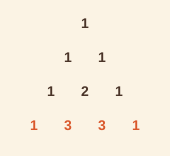 Expand (x + 2)³ with the Binomial Theorem.
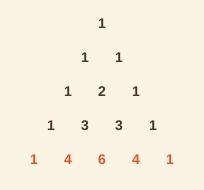 Expand (x - 1)⁴ with the Binomial Theorem.
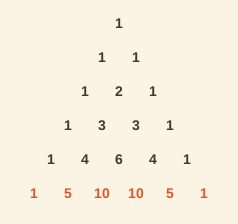 Use row 5 of the crew's planks, 1, 5, 10, 10, 5, 1. Expand (x + 1)⁵.Expand (2x - 1)³ with the Binomial Theorem.
Why every quadratic has two zeros
Here is the Fundamental Theorem of Algebra for degree 2, proved in six steps. Read it first, then put it in order below.
- Start with ax² + bx + c = 0 with a not 0. Divide every term by a.
- Complete the square: (x + b/2a)² = (b² - 4ac)/(4a²).
- Call the top b² - 4ac the discriminant D. The right side is D/(4a²).
- Every complex number has a square root. If D is negative, √D is i times √(-D).
- Take square roots of both sides: x + b/2a = ±√D/(2a). That gives two values, or one value twice when D = 0.
- So x = (-b ± √D)/(2a): exactly two zeros counting multiplicity, real or complex.
Check it with x² - 4x + 13. Here D = -36, so √D = 6i. Then x = (4 ± 6i)/2, which is 2 - 3i and 2 + 3i.
The one step that needs the complex numbers is the square root. Over the reals a negative D stops the proof. Over the complex numbers nothing stops it.
- ?Divide ax² + bx + c = 0 by a
- ?Complete the square: (x + b/2a)² = (b² - 4ac)/(4a²)
- ?Name the discriminant D = b² - 4ac
- ?Every complex number has a square root, even a negative D
- ?Take square roots: x + b/2a = ±√D/(2a), two values or one twice
- ?Solve: x = (-b ± √D)/(2a), exactly two zeros counting multiplicity
Which answer makes sense?
A classmate expands (x - 1)⁴ and gets all plus signs. Which check catches it? Put x = 1: the left side is 0, so the terms must cancel.
Another says x² + 9 has one zero, 3i. The theorem says two: 3i and its conjugate -3i. Conjugate zeros come in pairs.
| Statement | True or false? |
|---|---|
| In every term of (x + y)ⁿ, the powers of x and y add to n. | ? |
| (x - 1)⁴ has all positive coefficients. | ? |
| Completing the square works for every quadratic with a not 0. | ? |
| A negative discriminant stops the quadratic formula from giving zeros. | ? |
| 3 × 2 = 6 | ? |
Clear reasoning. Tomorrow fractions with polynomials in them, and why they behave like the fractions you know.