Friday
Friday: Rational Expressions, a System Like Fractions
"The hull needs a coat of sealant," Comet says. "If I coat the whole hull in x hours, I do 1/x of it per hour."
"And I take two hours longer," Wren says. "So I do 1/(x + 2) per hour. Together we do 1/x + 1/(x + 2)."
"That is adding fractions," Comet says. "What do you notice about the bottoms?"
"Different, so we need a common one," Wren says. "x times (x + 2). The sum is (2x + 2)/(x² + 2x)."
Nova projects 2/3 + 1/4 beside it. "Would you like a hint? The same moves work for numbers and polynomials."
"Common bottom, add the tops, cancel what you can," Comet says. "Fractions never left."
"Rational expressions are a system," Wren says. "Add, subtract, multiply or divide two, and you get another one."
A system like the fractions
A rational expression is a polynomial over a polynomial. The rational numbers are a whole number over a whole number.
Both systems are closed: add, subtract, multiply or divide two members (never dividing by 0) and the result is another member.
The moves are the same. Multiply tops and bottoms. Divide by flipping the second. Add or subtract over a common bottom.
One rule carries over too: the bottom can never be 0. For 1/x + 1/(x + 2), x cannot be 0 or -2.
The four moves
| Move | With numbers | With rational expressions |
|---|---|---|
| Multiply | 2/3 × 3/4 = 6/12 = 1/2 | (x)/(x + 1) × (x + 1)/(x²) = (1)/(x) |
| Divide | 2/3 ÷ 1/6 = 2/3 × 6/1 = 4 | (x² - 4)/(x + 1) ÷ (x - 2)/(x + 1) = x + 2 |
| Add | 2/3 + 1/4 = 8/12 + 3/12 = 11/12 | 1/x + 1/(x + 2) = (2x + 2)/(x² + 2x) |
| Subtract | 5/6 - 1/6 = 4/6 = 2/3 | (2x)/(x - 1) - (2)/(x - 1) = 2 |
Cancel common factors, never common terms. In (x² - 4)/(x + 1), the x² and the x are terms, so nothing cancels.
A coat finished by both in one hour means the combined rate equals 1: (2x + 2)/(x² + 2x) = 1. Week 3 solves equations like this.
- Read the question.
- Tap your answer.
- Read the question.
- Tap your answer.
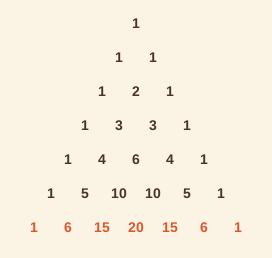 One more from the planks: in (x + y)⁶, what is the coefficient of x⁴y²?
| Statement | True or false? |
|---|---|
| Rational expressions are closed under addition, subtraction, multiplication and division by a nonzero expression. | ? |
| In (x² - 4)/(x + 1) you may cancel the x² with the x. | ? |
| To add two rational expressions you need a common denominator. | ? |
| 2 × 6 ÷ 3 = 4 | ? |
| Dividing by a rational expression means flipping it and multiplying. | ? |
Where the crew used this week's math
| Question | Tool | Answer |
|---|---|---|
| Factor x² + 4 | difference of squares with 2i | (x + 2i)(x - 2i) |
| Zeros of x² - 4x + 13 | quadratic formula, D negative | 2 - 3i and 2 + 3i |
| Coefficients of (x + y)⁶ | row 6 of the planks | 1, 6, 15, 20, 15, 6, 1 |
| Comet and Wren's combined rate | add two rational expressions | (2x + 2)/(x² + 2x) |
A full week of factoring and counting. Tomorrow is Dock Day: build Pascal's triangle with your family out of coins.