Wednesday
Wednesday: Boathouse Lab, Pascal's Planks
"The spare planks," Comet says, laying cardboard strips on the dock. "One on top, two below, three below that."
"Write a number on each," Wren says. "The outside planks all get 1. Every other plank gets the sum of the two above it."
Comet labels row by row. "1. Then 1, 1. Then 1, 2, 1. Then 1, 3, 3, 1. Then 1, 4, 6, 4, 1."
"That is Pascal's triangle," Wren says. "What do you notice if you add across each row?"
"1, 2, 4, 8, 16," Comet counts. "Doubling. Row 4 adds to 16."
Nova projects (x + y)² over the planks. "Would you like a hint? Expand it and read the coefficients."
"x² + 2xy + y²," Wren says. "1, 2, 1. Row 2. So row 3 should give (x + y)³."
A grown-up steadies the hull on its sawhorses, and nobody lifts a real plank alone.
What you need
- Cardboard or index cards cut into about 28 strips, a marker and your Boathouse Log.
- A flat floor or table big enough for seven rows.
- A few coins or tokens for counting paths down the triangle.
A grown-up is on the dock the whole time, and life vests are on near the water.
Nothing heavy is lifted alone. The real hull stays on its sawhorses.
Run the lab
- Lay one strip for row 0 and write 1 on it. Below it lay two strips, both labelled 1.
- For each new row, lay one more strip than the row above. Label the two ends 1.
- Label every inside strip with the sum of the two strips touching it from above. Build rows 0 to 6.
- Add the numbers across each row and record the sums in a table. Compare with powers of 2.
- Place a coin on the top strip. Count the different downhill paths to each strip in row 4, moving left or right.
- Compare your path counts with the numbers written on row 4.
The crew's plank rows
These are the crew's rows from Nova's log, built from cardboard on the dock. Yours should match exactly, because the rule leaves no room to differ.
| Row | Entries | Row sum | Power of 2 |
|---|---|---|---|
| 0 | 1 | 1 | 2⁰ = 1 |
| 1 | 1, 1 | 2 | 2¹ = 2 |
| 2 | 1, 2, 1 | 4 | 2² = 4 |
| 3 | 1, 3, 3, 1 | 8 | 2³ = 8 |
| 4 | 1, 4, 6, 4, 1 | 16 | 2⁴ = 16 |
| 5 | 1, 5, 10, 10, 5, 1 | 32 | 2⁵ = 32 |
| 6 | 1, 6, 15, 20, 15, 6, 1 | 64 | 2⁶ = 64 |
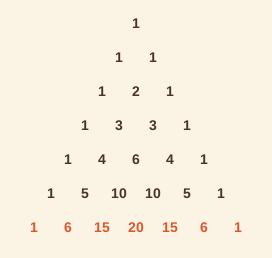
Why the planks give (x + y)ⁿ
Multiply (x + y)³ = (x + y)(x + y)(x + y). Each term picks x or y from each bracket. The coefficient of x²y counts the ways to pick one y from three brackets: 3.
Row 3 of the triangle is 1, 3, 3, 1, so (x + y)³ = x³ + 3x²y + 3xy² + y³. The entries count the picks.
Each entry is the sum of the two above because a path to it arrives from the left or from the right. Adding the two counts gives the new count.
The entry in row n, position k is written C(n, k). The row sum is 2ⁿ because every pick is x or y, two choices n times.
- Read the question.
- Tap your answer.
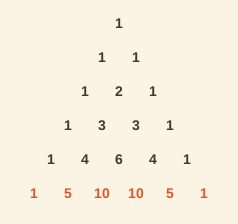 In the expansion of (x + y)⁵, what is the coefficient of x³y²?Row 6 of the crew's planks is 1, 6, 15, 20, 15, 6, 1. In (x + y)⁶, what is the coefficient of x³y³?
| What the lab shows | True or false? |
|---|---|
| Each inside entry of Pascal's triangle is the sum of the two entries above it. | ? |
| 1 + 4 + 6 + 4 + 1 = 16 | ? |
| The number of downhill paths to an entry equals the entry. | ? |
| The row sums of Pascal's triangle are 1, 2, 3, 4, 5. | ? |
| Row 2 of the triangle gives the coefficients of (x + y)². | ? |
Careful lab work. Tomorrow the triangle expands any binomial, and the quadratic formula proves the big theorem for degree 2.