Wednesday
Wednesday: Boathouse Lab, Distance and Angle
Morning on the dock. Comet chalks two axes across the planks with the gauge post as 0, one meter per square.
"Five light spots," Wren says, reading the lab list. "2 + 2i, 3i, -3 + 3i, -4, 1 - i. Mark each one."
Comet stretches string from the post to each mark. "Now the tape measure. How far is each light from the post?"
"2 + 2i reads about 2.8 meters," Wren says. "Its modulus is 2√2, which is close. What do you notice?"
Nova projects a protractor onto the chalk. "Would you like a hint? Measure the angle from the positive real axis too."
"2 + 2i is at 45 degrees," Comet says. "And -3 + 3i is at 135. A distance and an angle name the point as well as a + bi does."
A grown-up watches from the ramp, and life vests are on.
What you need
- Graph paper or a chalked grid on a patio, a tape measure or ruler, string and a protractor.
- Index cards for the five light spots and your Boathouse Log.
- Chalk only on a surface a grown-up has approved. Indoors, use graph paper with one centimeter per unit.
Cut cardboard or cards with scissors only. Nothing heavy is lifted alone.
A grown-up handles any ladder or stool used to reach a light.
Run the lab
- Draw the real axis across and the imaginary axis up. Mark 0 at the post and number each axis.
- Plot the five spots: 2 + 2i, 3i, -3 + 3i, -4, 1 - i. Label each with its a + bi name.
- Stretch string from 0 to each spot. Measure its length with the tape. Record it to one decimal place.
- Set the protractor at 0 with its base along the positive real axis. Measure each string's angle counterclockwise.
- Compute the modulus of each spot with a² + b². Compare it to your tape reading.
- Record the angle beside each spot. For spots left of the axis, keep measuring past 90 degrees.
The crew's readings
These are the crew's own made-up readings from Nova's log. Yours will differ a little, and that is the point of a lab.
| Spot | (a, b) | Tape (m) | Exact modulus | Angle |
|---|---|---|---|---|
| 2 + 2i | 2, 2 | 2.8 | 2√2 | 45° |
| 3i | 0, 3 | 3 | 3 | 90° |
| -3 + 3i | -3, 3 | 4.2 | 3√2 | 135° |
| -4 | -4, 0 | 4 | 4 | 180° |
| 1 - i | 1, -1 | 1.4 | √2 | 315° |
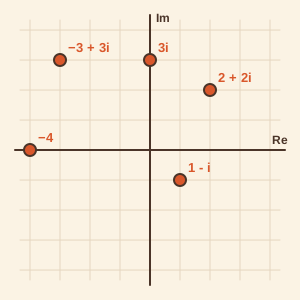
Polar form: a distance and an angle
The same point has two names. The rectangular name is a + bi, across and up. The polar name is a modulus r and an angle θ.
For 2 + 2i: r = 2√2 and θ = 45°. For 3i: r = 3 and θ = 90°.
Going back: a = r cos θ and b = r sin θ. A point with r = 2 and θ = 60° is 2 cos 60° + 2i sin 60°.
Both names point to the same dot on the chalk. That is why they represent the same number.
- Read the question.
- Tap your answer.
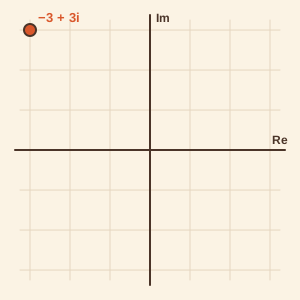 Spot -3 + 3i on the chalk grid. What are its modulus and angle?
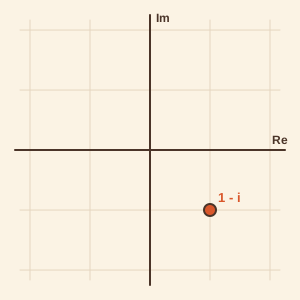 What are the modulus and angle (polar form) of 1 - i?
| What the lab shows | True or false? |
|---|---|
| The tape reading for 2 + 2i came out close to its modulus 2√2. | ? |
| The angle of a complex number is measured clockwise from the positive real axis. | ? |
| 3i has an angle of 90° because it sits on the positive imaginary axis. | ? |
| A point in polar form and the same point in a + bi form are two different numbers. | ? |
Careful lab work. Tomorrow we watch what adding, multiplying and conjugating do to a point on the plane.