Thursday
Thursday: Moves on the Plane
"Adding slides a point," Wren says, pinning the lab grid to the Boathouse wall. "Adding 1 + 4i to 3 + 2i moved it to 4 + 6i."
"And conjugating flips it," Comet says. "What does multiplying do? I cannot picture it."
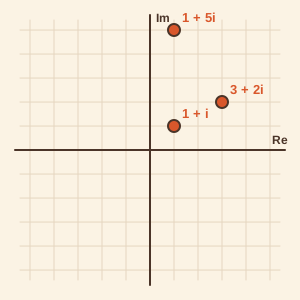
Nova projects 3 + 2i and then 1 + 5i. "That is 3 + 2i times 1 + i. Would you like a hint? Look at the modulus and the angle."
"The modulus went from √13 to √26," Wren says. "Times √2, the modulus of 1 + i. And the angle turned 45 degrees."
"So multiplying stretches by one modulus and turns by one angle," Comet says. "What can we make with that?"
"Powers," Wren says. "(1 + i)² turns 90 degrees and stretches to 2. It lands at 2i."
"Say why," Comet says. "Then I will believe it."
Three moves
- Adding w to z slides z by w: across by the real part of w, up by the imaginary part. Subtracting slides the other way.
- Conjugating z reflects it in the real axis. The modulus stays the same and the angle flips its sign.
- Multiplying z by w stretches the modulus by |w| and turns the angle by the angle of w.
Why multiplying adds angles
Here is the reason, in six steps. Read it first, then put it in order below. It uses the addition formulas for sine and cosine, which week 6 proves from a picture.
- Write z in polar form: z = r(cos α + i sin α). Write w = s(cos β + i sin β).
- Multiply: zw = rs(cos α + i sin α)(cos β + i sin β).
- Expand the brackets. Four terms appear. Two have no i, one has i, and one has i².
- Replace i² with -1. The real part is cos α cos β - sin α sin β. The imaginary part is sin α cos β + cos α sin β.
- The addition formulas say the first bracket is cos(α + β) and the second is sin(α + β).
- So zw = rs(cos(α + β) + i sin(α + β)): modulus rs, angle α + β.
Check it with numbers: 1 + i has modulus √2 and angle 45°. So (1 + i)² has modulus 2 and angle 90°, which is 2i.
And (1 + i)⁴ has modulus 4 and angle 180°, so it is -4. Multiply it out the long way and you get the same thing.
- ?Write z = r(cos α + i sin α) and w = s(cos β + i sin β)
- ?Use the addition formulas: cos(α + β) and sin(α + β)
- ?Expand the brackets into four terms
- ?Read off the result: modulus rs, angle α + β
- ?Multiply: zw = rs(cos α + i sin α)(cos β + i sin β)
- ?Replace i² with -1 and group the real and imaginary parts
- Read the question.
- Tap your answer.
| Statement | True or false? |
|---|---|
| Multiplying by i turns a point 90° counterclockwise without stretching it. | ? |
| Multiplying two complex numbers adds their moduli. | ? |
| Conjugating a number keeps its modulus and flips the sign of its angle. | ? |
| Adding 2 + i to a point slides it 2 across and 1 up. | ? |
| (1 + i)² = 2 + 2i. | ? |
Clear reasoning. Tomorrow two lights get a cable between them, and the modulus measures it.