Thursday
Thursday: The Brace Log
Raven opens the Blueprint Book to the brace log. "Every model wall gets a diagonal brace, corner to corner."
"Six by eight wall, ten brace," Rocket reads. "Nine by twelve, fifteen. The straws are cut already."
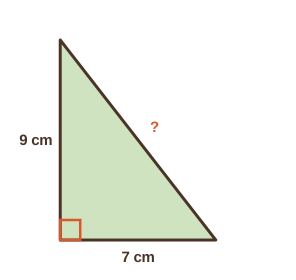
"What do you notice about the last wall?" Raven asks. "Seven by nine. The brace is not a whole number."
Rocket squares and adds. "Forty-nine plus eighty-one is 130. The square root is about 11.4."
Nova hovers above the storage box, her light shining into one corner. "A straw must lie flat inside," she says.
"Corner to far corner, through the box?" Rocket asks. "That is two triangles. Floor first, then up."
Nova hums. "Floor diagonal, then height. Measure twice before you cut."
Braces, flat and through a box
A brace runs corner to corner across a rectangular wall. The wall's width and height are the legs, and the brace is the hypotenuse.
When the sum of squares is not a perfect square, give the root to one decimal place. √130 is about 11.4.
For a diagonal through a box, go in two steps. First the floor diagonal, then that diagonal and the height.
These are the crew's own Blueprint Table measurements for the model clubhouse walls, in centimeters.
| Wall width | Wall height | Brace length |
|---|---|---|
| 6 | 8 | 10 |
| 9 | 12 | 15 |
| 5 | 12 | 13 |
| 8 | 15 | 17 |
| 7 | 9 | 11.4 |
The storage box is 3 by 4 by 12 cm. Floor diagonal: 3² + 4² = 25, so 5.
Then 5² + 12² = 169, and the square root is 13. A 13 cm straw just fits.
- Read the question.
- Tap your answer.
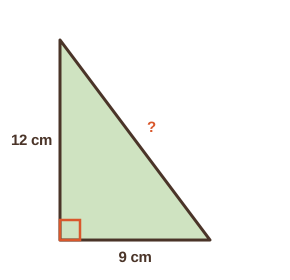 A wall is 9 cm wide and 12 cm tall. How long is its brace, in cm?
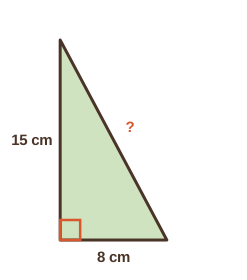 A wall is 8 cm wide and 15 cm tall. How long is its brace, in cm?A wall is 7 cm wide and 9 cm tall. How long is its brace, to one decimal place?
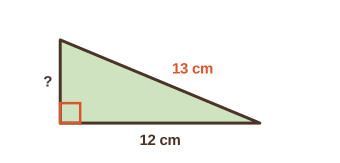 A brace is 13 cm long on a wall 12 cm tall. How wide is the wall, in cm?
- Read the question.
- Tap your answer.
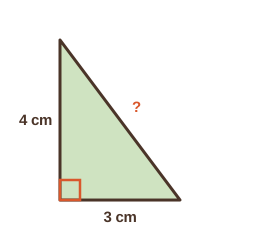 The box floor is 3 by 4 cm. How long is the floor diagonal, in cm?
| Statement | True or false? |
|---|---|
| The brace of a rectangular wall is the hypotenuse of a right triangle. | ? |
| A root that is not whole is written to one decimal place in this course. | ? |
| A diagonal through a box needs only one use of the theorem. | ? |
| Knowing the brace and the height, you can find the width. | ? |
Then measure the diagonal corner to corner. How close was the computed length?
Braces and box diagonals done. Tomorrow the theorem measures the grid and checks a corner.