Friday
Friday: Distances and Square Corners
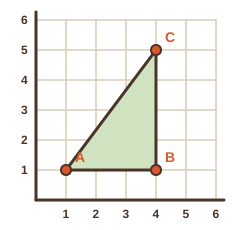
Rocket wants string lights from one grid point to another on the floor plan. "From (1, 1) to (4, 5). How much string?"
"What do you notice if you draw a right triangle between them?" Raven asks. Rocket draws it. "Run 3, rise 4."
"Nine plus sixteen, twenty-five. Five units of string!" He grins. "The theorem works on the grid too."
Raven checks a corner of the model wall with her finger. "Is this corner really square? It looks a bit off."
Nova hovers over the corner, her light marking 3, 4 and 5 centimeters along the edges and across. "Measure," she says.
Rocket measures the diagonal. "Five exactly. So 9 plus 16 equals 25, and the corner is square."
Nova hums. "The rule turned around checks a corner. Builders do this with string. Then review the week."
Distance between two grid points
Two points on the grid make a right triangle with a run and a rise. The distance between them is the hypotenuse.
From (1, 1) to (4, 5): run 4 - 1 = 3, rise 5 - 1 = 4. Distance = √(9 + 16) = 5.
When the sum is not a perfect square, give the distance to one decimal place.
The converse checks a corner
The theorem says: a square corner gives a² + b² = c². The converse turns it around.
If three sides have a² + b² = c², the corner between a and b is square. If not, it is not.
Builders mark 3 and 4 along two edges and measure across. A 5 means a square corner. The crew did the same with 30, 40 and 50 cm.
- Read the question.
- Tap your answer.
How far is it from (1, 1) to (4, 5)? (Give a whole number or one decimal place.)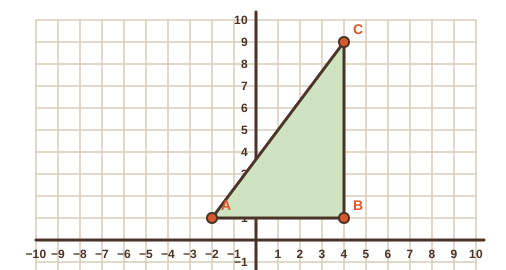 How far is it from (-2, 1) to (4, 9)? (Give a whole number or one decimal place.)
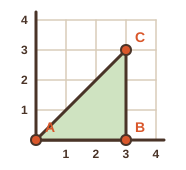 How far is it from (0, 0) to (3, 3)? (Give a whole number or one decimal place.)
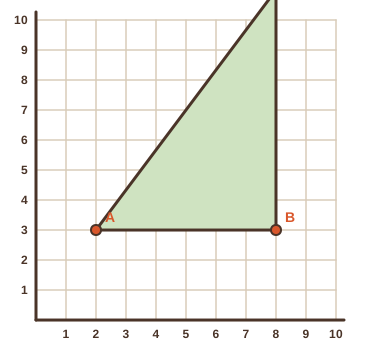 String lights run from (2, 3) to (8, 11). How many units of string?
- Read the question.
- Tap your answer.
| Week review | True or false? |
|---|---|
| In a right triangle the hypotenuse is opposite the square corner. | ? |
| a² + b² = c² works for every triangle, square corner or not. | ? |
| The distance between two grid points is the hypotenuse of a run-and-rise triangle. | ? |
| If a² + b² = c², the corner between a and b is square. | ? |
| A diagonal through a box uses the theorem twice. | ? |
- ?We leaned a ladder and found the hypotenuse from two legs.
- ?We measured string on the grid and checked a corner with 3, 4 and 5.
- ?We cut braces to length and ran a straw through a box.
- ?We counted squares on graph paper and the rows added up.
- ?We fit four triangles in a square to prove a² + b² = c².
Measure between the two marks. Is it 50 cm? Then the corner is square.