Wednesday
Wednesday: Build Lab, Squares on Graph Paper
Rocket tapes graph paper to the Blueprint Table and draws a right triangle with legs 3 and 4 squares.
"Now a square on each side," Raven says. "The leg squares are easy. Count them."
"Nine and sixteen," Rocket says. He draws the tilted square on the hypotenuse. "This one is a mess of half squares."
"What do you notice if you pair up the halves?" Raven asks. Rocket pairs them with his pencil. "Twenty-five!"
Nova hovers over the paper, her light counting along the tilted edge. "Now legs 6 and 8," she says. "Predict first."
"Thirty-six plus sixty-four. One hundred," Rocket says. "So the tilted square should count to 100."
Nova hums. "Count it. Measuring twice is how a prediction becomes a fact."
Your mission
Draw right triangles on graph paper and the square on each side. Count the little squares in each big square.
Predict the hypotenuse square from the two leg squares. Then count it, pairing half squares into wholes.
- Graph paper with small squares, a ruler and a pencil.
- Masking tape to hold the paper down, and colored pencils for the three squares.
- Scissors, in case you want to cut out the four-triangle proof.
- Your Blueprint Book.
Scissors only, with a grown-up nearby. Carry them point down.
- Draw a right triangle with legs 3 and 4 along the grid lines.
- Draw the square on each leg and count the little squares inside.
- Draw the square on the hypotenuse. Its corners land on grid points. Count whole squares, then pair the halves.
- Write all three areas in a table. Does leg square + leg square = hypotenuse square?
- Repeat with legs 6 and 8, then legs 5 and 12. Predict the hypotenuse square before you count.
The crew's counts
These are the crew's own counts from the Blueprint Table graph paper, in little squares.
| Leg a | Leg b | Square on a | Square on b | Square on c | c |
|---|---|---|---|---|---|
| 3 | 4 | 9 | 16 | 25 | 5 |
| 6 | 8 | 36 | 64 | 100 | 10 |
| 5 | 12 | 25 | 144 | 169 | 13 |
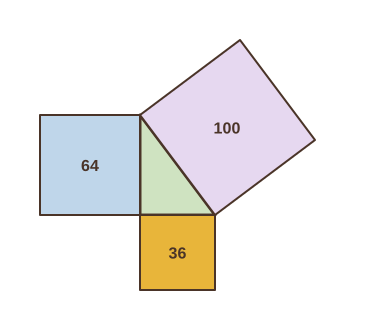
Each row adds up. The square on the hypotenuse counted to exactly the two leg squares together, every time.
- Read the question.
- Tap your answer.
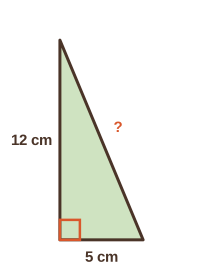 The hypotenuse square counted 169 little squares. How long is the hypotenuse?
| Statement | True or false? |
|---|---|
| Two half squares pair up to make one whole square. | ? |
| The square on the hypotenuse is always the biggest of the three. | ? |
| For legs 5 and 12, the hypotenuse square should count to 17. | ? |
Your counts matched the rule. Tomorrow the crew uses it on real braces for the model clubhouse walls.